From recognition to transformation: bridging the gap between understanding and lived experience
I originally developed RAPPORT as a means of guiding myself back to myself.
Having spent much of my life adapting to survive, I became increasingly curious about the relationship between my past experiences, my present responses and my capacity to make conscious choices about how I wanted to live.
I came to recognise that understanding why I responded in particular ways was only part of the process. I needed to accept my experiencing, become curious about it, process what emerged and put my learning into practice. Through observing and reflecting upon those experiences, transformation gradually became possible.
RAPPORT emerged from this natural process of experiential learning.
Recognise • Accept • Process • Practice • Observe • Reflect • Transform
Rooted in person-centred philosophy and informed by an understanding of trauma and protective adaptation, RAPPORT provides a framework through which we can develop a more compassionate, understanding and harmonious relationship with ourselves. It is not about fixing ourselves or becoming somebody different. It is about understanding ourselves sufficiently to develop the freedom to be ourselves.
Understanding our adaptations
Throughout our lives, we develop ways of responding to our environments, relationships and experiences. Many of these responses originate as protective adaptations, enabling us to navigate difficult circumstances, maintain relationships and survive adversity.
Whilst these adaptations may once have served an important purpose, they may continue to influence how we experience life long after the circumstances that necessitated them have changed. We may find ourselves responding to the present through the lens of the past, without consciously recognising that we are doing so.
RAPPORT invites us to become curious about these responses, understand their origins, recognise their function and explore whether they continue to serve us. Rather than asking What is wrong with me?, we might begin asking What is happening within me, what can I learn from it, and how might that learning serve me?
The intention is not to eliminate uncomfortable emotions, override protective responses or impose predetermined behavioural changes. It is to facilitate greater self-understanding, congruence, autonomy and freedom of choice.
The seven stages of RAPPORT

R – Recognise
What is happening within me?
Recognition involves bringing conscious awareness to our internal experiencing: thoughts, emotions, bodily sensations, impulses, behaviours or recurring relational patterns. It creates an opportunity to distinguish between what is occurring around us and what is occurring within us.
Example: I receive a brief text message and notice anxiety, a tight stomach and an urge to seek reassurance.
A – Accept
Can I acknowledge what I am experiencing without judging myself for it?
Acceptance involves allowing our experience to exist without immediately attempting to suppress, justify, defend or change it. It does not mean agreeing with every thought or accepting harmful circumstances.
Example: I accept that I feel anxious and fearful of rejection. My feelings are real, even though my interpretation may require further exploration.
P – Process
What can I discover through becoming curious about my experiencing?
Processing involves actively exploring emotions, sensations, associations, beliefs and memories that may underpin our responses. We might use reflective exploration, Emotional Freedom Techniques (EFT), somatic awareness or other appropriate therapeutic resources. The purpose is not to impose an explanation but to facilitate discovery.
Example: Through tapping and curiosity, I may discover that the brevity of the message reminds me of previous experiences of rejection.
P – Practice
How can I put what I have learned through RAP into practice?
Practice involves applying the learning that has emerged through Recognition, Acceptance and Processing to everyday life. We are not simply replacing a behaviour because someone has told us to. Our response emerges from our own understanding.
Example: I practise distinguishing between the information I have received and the meaning I have attached to it.
O – Observe
What happens when I put my learning into practice?
Observation involves noticing the consequences of applying our learning, internally and externally. We gather information from lived experience rather than judging ourselves according to success or failure.
Example: I notice whether considering alternative interpretations influences my anxiety or my interactions.
R – Reflect
What have I learned from this experience?
Reflection involves making sense of what we have observed: what has changed, what remains difficult, what has helped and what may require further exploration.
Example: I discover that I can experience uncertainty and ask for clarification without assuming another person has done something wrong.
T – Transform
How is this learning changing my relationship with myself and the world around me?
Transformation emerges through integrating learning into lived experience. Previously automatic responses may become more conscious, flexible and freely chosen. Transformation does not mean we never experience distress; our relationship with that experience may change.
Example: I increasingly trust my ability to explore and manage my experiencing whilst remaining open to clarification and connection.
RAP and PORT: Bridging the gap between understanding and lived experience
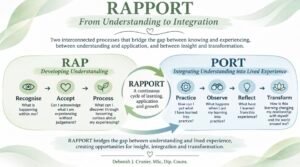
RAP – Developing understanding: Recognise, Accept, Process. Through RAP, we develop a compassionate and curious relationship with our internal experiencing and discover what it may be communicating.
PORT – Integrating understanding into lived experience: Practice, Observe, Reflect, Transform. Through PORT, we apply what we have learned, observe the consequences, reflect upon our experiences and gradually integrate that learning into how we live.
We may understand the concept of boundaries whilst continuing to struggle to establish them. We may understand emotional regulation whilst continuing to respond automatically when triggered. We may recognise the origins of our protective adaptations without yet discovering how to respond differently.
RAPPORT bridges the gap between knowing and experiencing, between understanding and application, and between insight and transformation. It is cyclical rather than strictly linear. Each new experience provides opportunities for further recognition, acceptance, processing and learning.
How and why RAPPORT may facilitate change
RAPPORT brings together several established psychological and therapeutic principles within an accessible, experiential framework.
Metacognitive awareness
Developing the capacity to observe our thoughts and interpretations rather than automatically accepting them as objective reality.
Self-acceptance and compassion
Reducing the additional distress that may arise through shame, self-criticism and resistance to our own experiencing.
Emotional and somatic awareness
Recognising the relationship between bodily sensations, emotions, memories, thoughts and protective responses.
Curiosity rather than judgement
Exploring the origins and functions of our responses without pathologising ourselves.
Experiential learning
Moving beyond intellectual understanding by applying discoveries, observing outcomes and reflecting upon lived experience.
Personal agency and an internal locus of evaluation
Developing trust in our own experiencing and increasing our capacity to make informed, autonomous choices.
RAPPORT in practice
RAPPORT is not exclusively a trauma recovery framework. It can be applied whenever we wish to better understand our experiencing, explore recurring patterns or develop a more harmonious relationship with ourselves.
Example 1 – People-pleasing and boundaries
An individual repeatedly agrees to requests despite feeling exhausted, subsequently experiencing resentment towards others.
| Stage | Application |
|---|---|
| Recognise | I notice resentment after agreeing to something I did not want to do. |
| Accept | I acknowledge my resentment without judgement. |
| Process | I discover that saying no is associated with fear of rejection. |
| Practice | I allow myself time to consider what I genuinely want before agreeing. |
| Observe | I notice how I feel when I give myself permission to decline. |
| Reflect | I discover that some relationships remain secure even when I say no. |
| Transform | I increasingly make decisions based on genuine preferences rather than fear. |
Example 2 – Substance use and comfort eating
An individual turns to alcohol, food or another substance or behaviour to manage uncomfortable internal experiences.
| Stage | Application |
|---|---|
| Recognise | I notice the urge to drink or eat when overwhelmed. |
| Accept | I acknowledge the urge without shame. |
| Process | I explore what I am experiencing and what function the behaviour serves. |
| Practice | I explore other ways of responding to the underlying need. |
| Observe | I notice whether these responses influence my experiencing or the intensity of the urge. |
| Reflect | I consider what helps and what requires further exploration. |
| Transform | I develop a more conscious and flexible relationship with my needs and behaviours. |
RAPPORT may complement appropriate substance-use treatment and recovery support. It is not a replacement for medical care, supervised withdrawal or specialist treatment where required.
Example 3 – Interpersonal relationships and perceived rejection
An individual frequently interprets ordinary interactions as evidence of rejection.
| Stage | Application |
|---|---|
| Recognise | I notice that I anticipate rejection before an interaction. |
| Accept | I acknowledge my fear without judgement. |
| Process | I explore how previous experiences may influence my interpretation. |
| Practice | I distinguish between available information and the meaning I attach to it. |
| Observe | I notice what happens when I remain curious. |
| Reflect | I discover that my interpretation is not necessarily another person’s intention. |
| Transform | I increasingly experience relationships with flexibility, trust and personal agency. |
This does not mean dismissing genuine experiences of rejection or mistreatment.
Example 4 – Moving from surviving to living: a personal reflection
Having spent much of my life adapting to survive, I have always considered my ability to adapt, persevere and find a way forward to be amongst my greatest strengths. My affirmation throughout much of my life has been: What can you do? How do you move forwards?
However, I recently became curious about whether my ability to survive had inadvertently become the organising principle of my life. Had I become so accustomed to overcoming difficulties that I was overlooking opportunities to simply enjoy living?
| Stage | Application |
|---|---|
| Recognise | I recognise that much of my life has been organised around overcoming challenges. |
| Accept | I acknowledge that these adaptations have served me well, whilst recognising their potential cost. |
| Process | I become curious about why movement, achievement and problem-solving have become so important. |
| Practice | I begin making room for pleasure, rest and connection without requiring a productive purpose. |
| Observe | I notice the joy of reconnecting with a longstanding friend and celebrating my graduation. |
| Reflect | I discover that I can experience aliveness without urgency or struggle. |
| Transform | I begin to consider how I might organise my life around what I genuinely want rather than what I can endure. |
This is an ongoing process rather than a completed transformation. RAPPORT is equally concerned with recognising what nourishes us and integrating that understanding into our lives. Perhaps my affirmation is evolving: What do I want? What brings me joy? How do I create a life I love living?
I have survived. I have adapted. And now, perhaps, it is time to live.
RAPPORT as a transferable life skill
RAPPORT may be applied in person-centred counselling, complex trauma recovery, EFT-informed practice, drug and alcohol recovery support, personal development, emotional regulation, relational difficulties, boundary development, workplace wellbeing, burnout prevention and life transitions.
It can be used retrospectively, in the present or proactively. There is no requirement to complete all seven stages in one sitting. We may return to Recognition, Acceptance or Processing whenever new information emerges. We may also recognise that we require additional support to explore particular experiences safely.
RAPPORT is an ongoing process of developing a relationship with ourselves, not a task to complete or another standard against which to judge ourselves.
The role of the practitioner
Within a therapeutic context, the practitioner facilitates the individual’s exploration, not its outcome. Through empathy, congruence, unconditional positive regard and appropriate therapeutic resources, the practitioner supports the individual in developing their own understanding.
The practitioner facilitates the process; the individual owns the learning.
As familiarity with RAPPORT increases, the individual may become increasingly able to engage with the process independently, whilst recognising when additional support is needed. The intention is not independence at the expense of connection. Human beings benefit from meaningful relationships, mutual support and co-regulation. Processing should always be paced according to the individual’s capacity and sense of safety. Particularly when exploring traumatic material, professional support may be necessary.
What RAPPORT seeks to facilitate

- Self-awareness without self-condemnation.
- Acceptance without resignation.
- Curiosity without judgement.
- Understanding without pathologising.
- Responsibility without self-blame.
- Autonomy without isolation.
- Transformation without the rejection of self.
Our existing adaptations are acknowledged and understood within the context in which they developed. The intention is to expand our freedom to choose how we respond, rather than remain governed exclusively by previously established protective patterns.
The relationship with self
A harmonious relationship with ourselves does not mean that we never experience internal conflict, emotional discomfort or uncertainty. It means developing the capacity to remain connected to ourselves through those experiences.
It means listening to ourselves with the same curiosity, compassion and consideration that we might readily extend to another person. It means recognising our limitations without overlooking our capabilities, and acknowledging what has happened to us whilst retaining ownership of our choices.
RAPPORT is not about becoming a better version of ourselves. It is about developing a more harmonious relationship with who we are, whilst creating the freedom to discover who we might become.
Through understanding ourselves, we develop the freedom to be ourselves.
RAPPORT – Creating a Harmonious Relationship with Self.
Not about fixing ourselves. About finding our way back to ourselves.
RAPPORT is a person-centred, trauma-informed experiential framework developed by Deborah J. Crozier. Whilst it draws upon established psychological and therapeutic principles, RAPPORT as a complete framework has not yet been independently evaluated. Its proposed benefits should therefore be understood within that context.