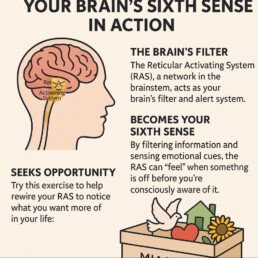
RAS-A-Mataz! Your Brain’s Sixth Sense in Action
Ever walked into a room and felt something was off before anyone said a word?
That’s not imagination — it’s your Reticular Activating System (RAS) at work.
The RAS sits deep in the brainstem and acts like your inner filter. It decides what information reaches your awareness and what fades into the background. It constantly scans your surroundings for what feels important — and here’s the key — it doesn’t just look for danger. It looks for whatever you’ve trained it to find.
After trauma, the RAS often becomes finely tuned to threat — alert, cautious, and on guard. But with awareness and practice, it can be gently retrained to seek safety, connection, opportunity, and growth instead.
One way I help people (and myself) to do this is through a simple but powerful exercise I call Mia Vita — My Life.
I fill a shoebox with small reminders of what I want to invite into my world: peace, love, health, connection, creativity, abundance. It’s like a 3D vision board — a tangible reflection of intention. Over time, my RAS starts noticing those same qualities showing up around me. What we focus on truly expands.
Try it yourself:
- Create your own Mia Vita box or vision board.
- Spend a few mindful minutes each day connecting to it.
- Feel the emotions of already having those experiences.
- Notice how your awareness — and your world — begins to shift.
The Neuroscience
The Reticular Activating System (RAS) is part of a network in the brainstem that regulates arousal, attention, and focus. It decides what information reaches conscious awareness — shaping what you notice about the world.
When you live in a prolonged state of threat or stress, your RAS and nervous system adapt to stay on high alert. You’re, in effect, practising hypervigilance every single day. And just like practising any skill, repetition strengthens those neural pathways.
Over time, your brain becomes exceptionally good at spotting danger — but that same neuroplasticity can work in your favour. With intention, mindfulness, and consistent focus, you can teach your RAS to look for peace, possibility, and safety instead of fear.
What you focus on, your brain learns to find.
And that’s the real RAS-A-Mataz — your sixth sense, rewired for growth.
Energy flows where focus goes — what you focus your attention on is what you experience in your reality.

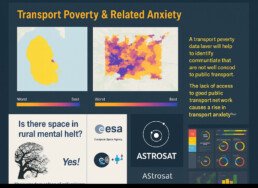
When Care Becomes Control: A Trauma-Informed View on Technology and Mental Health
With so much talk in the media lately about Digital ID — and the growing public concern around surveillance, privacy, and data control — I’ve found myself reflecting on how easily good intentions can blur into overreach.
While technology continues to promise safety, convenience, and efficiency, many people instinctively feel uneasy about the potential for misuse or intrusion. This tension between innovation and autonomy reminded me of a conference I attended a few years ago, where I experienced that same uneasy feeling first-hand.
I attended an online presentation by a space technology company called Astrosat, based in Musselburgh, who work in partnership with the European Space Agency. They shared some fascinating projects — using satellite data to map fuel poverty, access to green spaces, rural isolation, and community wellbeing. It was inspiring to see how technology could be used to inform positive change and direct resources where they’re most needed.
But then something caught my attention.
Among the ideas shared was a proposal to track people identified as being at suicide risk, using their phone’s location data to alert emergency services if they approached known “hot spots” such as bridges. The intention was clearly compassionate — to prevent loss of life — but I felt an immediate discomfort.
As a person-centred counsellor, my work is rooted in autonomy, trust, and unconditional positive regard. The idea of monitoring individuals without consent, even in the name of safety, felt like crossing an ethical line.
The human cost of overreach
In trauma work, we understand that safety is not something that can be imposed. It’s something that must be co-created through trust and relationship.
For someone already struggling with their mental health, the sudden arrival of emergency services — possibly lights flashing and voices shouting — could be terrifying and re-traumatising. Imagine simply walking home across a bridge, lost in thought, and suddenly being surrounded by responders because an algorithm flagged your location.
What might have begun as an act of care could easily be experienced as control, and for some, confirmation of their deepest fears — that they can’t trust the world around them, that their privacy no longer exists, that even their thoughts are being monitored.
Paranoia would be off the scale.
The heart of person-centred work is believing in an individual’s right to self-determination — even when they’re struggling. We walk alongside people, not in front of them, and we offer choices, not commands. Safety achieved through surveillance is not true safety; it’s a form of fear management.
Technology that listens, not watches
This doesn’t mean technology can’t play a role in supporting mental health. It absolutely can — but it needs to be grounded in consent, compassion, and collaboration.
Here are a few examples of how tech could help ethically:
- Opt-in digital companionship apps that people activate when they choose to, offering real-time human support or grounding exercises.
- Anonymous environmental mapping, where data helps authorities design safer spaces without tracking individuals.
- AI-assisted empathy training, supporting professionals to recognise emotional tone or distress in messages — not to monitor people, but to deepen human understanding.
- Digital regulation tools that teach simple nervous system calming practices like breathing, tapping, or the Voo sound — empowering self-regulation, not surveillance.
- Community-based safety networks, where awareness and care are built through relationships rather than algorithms.
Technology should never become the new gatekeeper of human distress. Its highest purpose is to extend empathy, not authority.
Protecting both life and liberty
When care becomes control, we lose the essence of healing — and replace it with compliance. True trauma-informed practice means protecting both life and liberty.
If technology is to be used in mental health, it must be designed in partnership with those who understand the lived experience of trauma, distress, and recovery. It must recognise that being watched is not the same as being seen.
As we continue to innovate, may we never forget that the most powerful technology we possess is still the human heart — capable of listening, understanding, and connecting in ways no algorithm ever could.
“We can design systems that protect without intruding, and save lives without silencing them.”
Deborah J Crozier
Founder at A Positive Start CIC
Trauma-Informed Practitioner supporting community holistic health and safety
Member of the Association of Child Protection Professionals and Chartered Fellow Member of the ACCPH

When People Try to Turn Others Against You
It’s something we see everywhere — from gutter media & politics to workplace bully's, even within families, so called friendships and community groups.
Someone hears something they don’t like or disagrees with your truth, and instead of having a respectful conversation, they try to influence others against you.
It often shows up as gossip with a spiteful edge — subtle comments, half-truths, or outright lies designed to discredit and isolate.
But here’s the thing:
People who do this reveal far more about themselves than they do about the person they’re targeting.
A person who smiles to your face but speaks badly of you when you’re not around shows you exactly who they are.
And the irony? These things rarely stay secret. People talk. Word travels. And when someone shows they’ll badmouth one person they pretend to like, others quickly realise they’ll do the same to them.
This kind of behaviour comes from insecurity and unhappiness — not strength.
Like a lemon when squeezed, what’s inside comes out. When life applies pressure, bitterness can’t hide behind a mask.
True integrity means showing up with consistency — being the same person in every room, whether the cameras are on or not.
No photo opportunity, title, or volunteer badge can cover what’s inside.
And then there are boundaries.
People who struggle to communicate and hold their own boundaries often find it difficult to respect those of others.
They experience boundaries as rejection — as if your “no” is a personal attack rather than a healthy expression of autonomy.
When called out, they may cry, become defensive, or excuse their behaviour with phrases like, “I was only trying to help.”
What’s really happening inside in those moments is that the ego steps in as a protector — an inflated version of self that shields them from seeing the truth.
Looking in the mirror of self-awareness can be confronting. It’s far easier to point fingers at others than to face what’s being reflected back.
When the mirror shows something uncomfortable — guilt, envy, insecurity, or shame — the unhealed parts of ourselves rush to defend, deflect, and deny.
The ego whispers, “It’s not you — it’s them.”
And that whisper becomes a wall between growth and accountability.
But the reality is, the mirror isn’t the enemy — it’s the messenger.
If the reflection feels painful, it’s a sign that something inside needs attention, not avoidance.
Because until we face those wounds, we risk bleeding on people who didn’t cut us.
Healing asks for courage — to sit with discomfort, to trace reactions back to their roots, and to meet the parts of ourselves we’d rather hide.
That’s where growth begins: not in defending our pain, but in understanding it.
But overriding someone’s choice is never help — it’s control disguised as care.
Truth can sting when it reflects something we don’t want to see in ourselves. Yet that discomfort is the doorway to growth, if we’re willing to step through it.
As my youngest son once said — dealing with your feelings is a lot like dealing with a fart.
We all have them, and pretending we don’t just makes us sick. Holding things in might seem polite or convenient, but it always leads to pressure, discomfort, and eventually… a bit of a mess. 💩
It’s far healthier to let those feelings out — to sit with them, notice them, and understand what they’re trying to tell you.
They’re uniquely yours, part of your internal landscape, and they deserve your attention.
Sometimes it helps to “fart with a friend” — to share what’s coming up in a safe, non-judgemental space.
And yes, occasionally that friend might release a whole load of their own stuff too — that’s okay. It all needs to come out.
So the next time your emotional tummy rumbles, take a breath, brace yourself, and let it move through.
Healing doesn’t always smell pretty, but it’s always better out than in.
And here’s another truth:
People who thrive on negativity often like nothing better than to see others fail.
They quietly rejoice when they hear someone is struggling or lonely — their smiles masking a sense of satisfaction that another person’s light has dimmed.
They pretend to be kind and gentle, but their energy tells a different story. Beneath the surface lies harshness and cruelty, a projection of their own inner misery.
A lack of self-awareness allows them to overlook their own toxic behaviours while blaming others for the very traits they refuse to see in themselves.
And it’s this lack of awareness that makes them perfect flying monkeys for narcissists.
The term “flying monkey” comes from The Wizard of Oz — the winged creatures who did the witch’s bidding without question.
In emotional and relational terms, it describes people who act on behalf of a manipulator or narcissist — spreading rumours, taking sides, or attacking those the narcissist has targeted.
Often, these individuals believe they’re doing the right thing. They’re drawn in by charm, pity, or persuasion, and end up defending behaviour that is harmful or abusive.
Flying monkeys create further harm by validating the narcissist’s distorted narrative and silencing the person being targeted.
Their actions can destroy reputations, relationships, and emotional safety — not only for others, but for themselves.
Because each time they gossip, exclude, or attack at someone else’s request, they disconnect further from their own truth, integrity, and peace.
And this is the tragedy:
Flying monkeys usually don’t realise they’re being used as tools of manipulation.
They confuse loyalty with obedience, and empathy with enabling.
By the time the narcissist turns on them — as they almost always do — deep shame and confusion often follow.
Healing begins when we step out of that dynamic.
When we learn to question motives, stay neutral, and refuse to carry anyone else’s poison.
When we stop feeding toxic systems — and instead choose curiosity, compassion, and critical thinking.
You’ve likely heard the saying, “The enemy of my enemy is my friend.”
It perfectly sums up how toxic alliances are often formed.
Gossipers and manipulators may appear united, but the only real bond they share is mutual negativity — a temporary sense of belonging built around tearing someone else down.
These connections aren’t rooted in respect or shared values; they’re rooted in resentment and pain.
It’s not friendship — it’s a trauma bond disguised as solidarity.
When the common target changes, the alliance usually collapses.
Because underneath it all, gossipers don’t actually trust one another — they simply need validation for their own discomfort.
And once that need is met, they’ll eventually turn on each other too.
This behaviour is especially damaging when it happens within families.
When parents or relatives fall out and use gossip or manipulation to destroy one another, it’s the children who suffer most.
They become caught in the middle of adult conflicts that have nothing to do with them, forced to absorb the emotional fallout.
Toxic gossip in families is not harmless — it is psychological abuse.
It teaches children that love is conditional, that truth is distorted, and that loyalty means choosing sides.
When adults prioritise revenge over a child’s emotional safety, everyone loses.
The bitterness consumes the storyteller first — because gossip is like a big black dog: it might look like it’s attacking someone else, but eventually, it circles back and bites the hand that feeds it.
What we put out always finds its way home.
The healthiest choice is to step outside that world entirely.
Observe it for what it is — destructive, cyclical, and sad — and refuse to be part of it.
Because here’s where real maturity lies:
We don’t need to agree to respect each other.
The world is big enough for all views, all opinions, and all experiences.
Disagreement isn’t the problem — the problem begins when one person cannot tolerate another’s differing view or boundary and turns nasty as a result.
When they twist difference into division, and respect into rejection.
And healing — real healing — means noticing these same tendencies within ourselves and refusing to participate in them.
It asks us to listen to individual truths, not to accept gossip or negative labels assigned to others.
Healing invites us to look beyond the shaming words and see the truth for ourselves.
It asks us to be accountable for our own actions and aware of the energy we bring into the world.
To give ourselves the chance to listen and learn first-hand, and to make our own judgements based on how people live their lives — their actions, not others’ opinions.
And none of us are perfect.
We are all learning, growing, and developing.
To become happier and healthier in ourselves, we have to learn about our internal landscape — the emotions, stories, and beliefs we hold, and how they shape our lives and influence the kind of world we create together.
That’s how we break the cycle.
That’s how we lead with integrity.
And that’s how we heal.
Stay grounded.
Stay kind.
And keep your boundaries intact — they’re not walls to keep people out, but filters that protect your peace.
If you find yourself in a position — either speaking toxic gossip or absorbing it from others — pause for a moment and ask yourself quietly:
What is my intention here?
What am I part of?
Am I adding to the problem or moving toward understanding?
Am I being a destructive force, or can I accept that I always have a choice?
I don’t need to judge, criticise, blame, or label anyone.
I can choose silence. I can choose reflection.
I can choose to move toward rupture and repair — or simply to step back and do nothing.
Recognise - toxic gossiping is a dysregulated behaviour. Just because many people do it, doesn’t make it right!
And if I do choose to participate in the character assassination of another, dare I ask myself, with grace and honesty — why?
Because that question — asked with sincerity, not shame — is where healing begins.

How Far is “Farthest”? Rethinking the Language of Welfare and Worth
When the Department for Work and Pensions classifies someone as “furthest from the labour market,” it might sound like neutral language — a simple policy term.
But for the person it describes, already living in a state of survival, it can feel like a final verdict.
“Farthest” sounds unreachable. Irredeemable. Beyond help.
And when your nervous system is already in collapse — exhausted, anxious, and numb — those words don’t just label you. They confirm what trauma has already whispered: you’re too far gone.
But here’s the truth — how far is farthest, really?
In reality, it’s just one step. One step towards self-care. One step towards safety. One step towards believing again that change is possible. Then another step, and another, until momentum builds and evidence replaces despair.
When Systems Speak Fear Instead of Hope
I’ve often asked myself — why does government policy use such negative, dehumanising language?
When we label people as “work-shy,” “scroungers,” or “furthest from the labour market,” we reinforce stigma, not self-worth. Those words don’t motivate; they immobilise.
People living on benefits are often demonised and treated as an underclass. Many live under constant scrutiny — afraid to enjoy a coffee with a friend or buy a pair of shoes for fear of being judged. Others dare not dream of a better life because the risk of losing their only income feels too high.
Hopelessness becomes a policy outcome — not because people don’t care, but because they’ve been conditioned to believe they don’t count.
A Positive Start — From Prevention to Recovery
When I first created A Positive Start, it wasn’t for adults at all — it was for young people in secondary school (11+).
I wanted to teach them early — the life lessons I had to learn the hard way — how to understand their emotions, protect their wellbeing, and recognise unhealthy dynamics before they took root.
But despite my best efforts, I couldn’t get anyone in education to even look at it, let alone implement it. I was asked to prove outcomes for a problem that hadn’t yet happened — an impossible task. Prevention, it seems, doesn’t fit comfortably into systems that measure only crisis response.
So, I took it to the other end of the scale — the Job Centre — where people classed as “farthest from the labour market” were living what I had once lived.
And I knew I could help.
When I formed A Positive Start CIC in 2017, one of the first things I did was register on the DWP’s DPS system — a mammoth process that took months of work. We were accepted and awarded a four-year agreement to deliver services through the Job Centre.
But despite all that, not a single referral ever came through.
The system, as it stands, doesn’t allow local Job Centres to choose who they partner with. Even with proven impact, compassion-based solutions rarely make it through the bureaucracy. So instead, I continued delivering our programs as a free service — because the need didn’t disappear just because the paperwork said “no.”
My Story: From Survival to Purpose
Many years ago, after escaping domestic violence, I found myself trapped in that same system. I was anxious, isolated, and experiencing panic attacks, agoraphobia, and depression.
At the Job Centre, I was advised not to work — because once childcare was factored in, I’d be “no better off.” So, I stayed on benefits, stuck in a cycle I didn’t want but didn’t know how to leave.
Everything changed when my children and I were relocated for safety. I remember that first morning in our new home — hearing car doors slam as people left for work. My eldest looked out of the window and asked, “Where is everyone going, Mummy?”
That question broke me open. My children hadn’t known a life where people went out to work. That morning, I decided to show them a different story — that you can build the life you want, even after trauma.
I put an advert in a local shop window for childcare and found Mabel, a retired woman who became part of our family. I worked evenings in community home care while the children slept, and later, when they were older, I moved into social services.
Our lives changed because I made a choice to take one small step — and then another. Not because I was forced, sanctioned, or coerced. Those dynamics would have sent me straight back into survival.
Why Sanctions Don’t Work — and Compassion Does
When people are in survival mode, the nervous system prioritises safety, not progress.
Punishment, fear, and pressure mimic the same power dynamics that often caused their trauma in the first place.
Stephen Porges describes this as dorsal collapse — a state where the body shuts down to protect itself. In that state, no one can “engage” or “comply.” They are not lazy; they are frozen.
Healing begins not with punishment but with presence.
When we offer empathy, understanding, and a safe relational space, people start to regulate. And when they regulate, they rise.
As Viktor Frankl wrote in Man’s Search for Meaning:
“Those who have a ‘why’ to live can bear almost any ‘how.’”
The tragedy of our welfare system is that many have lost their why — not through lack of will, but through loss of hope.
The 6 Rs Pathway to Purpose helps people rediscover meaning and contribution, reigniting the human spirit that sanctions and fear cannot touch.
That’s why I created The 6 Rs Pathway to Purpose — a trauma-informed route from reliance to resilience, purpose, and prosperity. It begins with self-care and awareness, helping people reconnect with their own worth before taking steps towards employment.
Because what is often called “attention-seeking” is really connection-seeking — and what is called “work-shy” is often safety-seeking.
The Hidden Cost of Survival Mode
In my counselling work, I see first-hand the fear and panic that arise whenever a PIP review or benefits reassessment is due. For many, it’s an intensely dysregulating experience.
When you’re already in survival mode, your nervous system floods with anxiety. You overthink, catastrophise, and fall into black-and-white thinking. Every core belief of unworthiness, helplessness, and shame comes alive again.
The fear of annihilation — the sense that your entire existence could be wiped away with one decision — becomes very real.
And what is trauma, if not the fear of annihilation replayed in the present moment?
Survival mode is reactivated, and the person shuts down. That’s not “non-compliance”; it’s self-protection.
The Way Forward — The TRUST Framework
The way not to trigger survival mode — and not to deepen despair — is through compassion.
At A Positive Start CIC, we use the TRUST Framework:
T – Trigger Recognition: Identify what activates fear or collapse.
R – Reassurance: Offer calm, non-judgmental support.
U – Understanding: Listen deeply to the person’s story without assumption.
S – Safety: Create emotional and psychological safety before taking action.
T – Truth: Build confidence through honesty, transparency, and consistency.
This approach allows us to circumvent survival-mode triggers, rebuild self-worth, and help people step forward with confidence.
A Compassionate Clarification
I want to be clear — I don’t imagine that just because this worked for me, it will work for everyone. Healing and recovery are never “one size fits all.”
My approach does not include, nor does it seek to pressure, people whose disabilities or health conditions make working an impossible task. For some, safety, rest, and care are the true priorities. They are, however, always welcome to participate in programs like The 6 Rs Pathway to Purpose should they wish to — for connection, growth, or community support.
The people I’m talking about here are those, like me, who have experienced trauma that led to shutdown, dysregulation, and disconnection — often through experiences such as:
- domestic or childhood abuse,
- long-term stress or coercive control,
- bereavement, homelessness, or poverty,
- caring for dependents under extreme pressure,
- bullying, workplace burnout, or chronic anxiety.
For many, these experiences are not isolated — they overlap, creating a lasting imprint on both mind and body.
In the UK today, more than 1.8 million people are considered economically inactive due to long-term illness, with around half reporting anxiety, depression, or trauma-related conditions. Many of them desperately want to work — but their nervous systems and circumstances keep them locked in survival.
A trauma-informed approach like The 6 Rs Pathway to Purpose acknowledges this reality. It recognises that you can’t build employment pathways on top of unhealed survival states. You have to start with safety, understanding, and emotional regulation — not sanctions and fear.
This is not about pushing people back into work. It’s about helping people rediscover self-worth, confidence, and meaning, so that work — or purposeful activity — becomes possible, sustainable, and fulfilling.
When we meet people with compassion instead of criticism, and with trust instead of threat, the results ripple far beyond the individual.
Communities become stronger.
Families thrive.
Society heals.
This is what a trauma-informed welfare system could look like — one rooted not in judgement, but in justice and humanity.
One Step at a Time
So, how far is “farthest,” really?
It’s not a distance measured in policies or performance metrics — it’s one small human step, taken in safety, trust, and compassion.
I took that step once, and it changed my life.
Now, I help others take theirs.
My Intention — From the Borders to the Nation
My vision is to see The 6 Rs Pathway to Purpose piloted in the Scottish Borders and the North West of England over a 12-month period.
These are regions where the effects of poverty, trauma, and generational unemployment are deeply felt — but so too are resilience, compassion, and community spirit.
With time, care, and evidence, this initiative can show that trauma-informed welfare reform doesn’t just change lives — it transforms systems.
Once the pilot demonstrates what I already know in my heart — that positive outcomes begin with A Positive Start — I hope to see it rolled out across the UK, creating a fairer, more compassionate pathway to purpose for all.
“Hopelessness is not who you are — it’s what your nervous system learned to survive. And with the right support, every person can find their way from poverty to purpose.”
17 Years of A Positive Start: From Rock Bottom to Rising Strong
Seventeen years ago today, I began a journey that I called A Positive Start.
At the time, I’d been working on myself for a while, trying to make sense of why I kept ending up back at square one. The thing about dysregulation and survival mode is that while you’re living in it, you don’t see it — not in yourself and not really in others. But once you do see it, you can’t unsee it, and you begin to notice it everywhere.
I was living in West Cumbria then, once again unemployed and feeling like I’d gone full circle. I’d already been labelled by the DWP as “farthest from the labour market,” and despite my determination never to end up there again, there I was — back in that same place, feeling defeated and desperate.
So I decided to start again, but differently this time. I’d tried every road and they all led me back to where I began. This time, I took a new route — a positive one. Not “positive” in the toxic sense of pretending everything was fine, but in the sense of becoming positive about myself. I chose to stop hating myself for every mistake and blaming myself for everything that had happened.
Instead, I began to look within — with compassion — and ask myself,
“What is it about me? What part am I playing in my own life? What am I responsible for, and what am I not?”
Each day I went to the library in Cleator Moor to read, write, and learn. Slowly, from that place of curiosity and self-reflection, A Positive Start was born.
In those early days, I had no money. I couldn’t even afford the bus fare, so I walked to youth centres to deliver free sessions. I held teatime discussions with young people and their friends, asking what issues they faced and how they thought change could happen. They taught me more than I could ever have imagined.
Then one day, things started to shift. I applied for a job as a project manager for a charity that wanted someone to build a new project from the ground up — to recruit, train, and support people. Initially, I was told I was unsuccessful. But the night before the interviews, they called to say someone had dropped out and asked if I’d like to attend.
I arrived prepared — not with a PowerPoint presentation, but with a strip of old wallpaper covered in images I’d stuck on the back. I shared my vision straight from the heart. The room went silent. I was asked to step outside for a moment. When they called me back in, they told me that all four board members had decided unanimously: the job was mine.
That moment changed everything.
I began recruiting people from the job centre — people who, like me, had once been considered “farthest from the labour market.” Many were survivors of trauma and abuse. Within nine months, our project was awarded the SUSE Gold Award for Equality and Inclusion, and the job centre reported major improvements in clients’ wellbeing, health, and ability to work.
But after that award, things changed.
The charity that had originally supported me to deliver A Positive Start — giving me total autonomy and repeatedly stating they had no interest in the training side — suddenly saw a new opportunity for funding. Once the award and results of our collaboration were public, they approached me, offering to renew my contract for another year and give me a small pay rise, but on one condition: that I hand A Positive Start over to them so they could run it as their own.
I refused.
I agreed to collaborate with them and let them access funding to provide placements, but A Positive Start would remain my copyright — my life’s work, born from lived experience.
That decision changed everything. The chair stopped speaking to me. When I returned from annual leave, members of my team quietly told me that two board members had come in and demanded they download all of my training materials. Soon after, the job centre manager requested a private meeting and disclosed that those same board members had visited her too — asking if the DWP would continue the training without me. She had been instructed not to tell me.
I was devastated. The illusion of charity equals honesty and integrity was shattered. My trust was broken.
I served my notice and left. It was one of the hardest but most defining choices of my life. From that point forward, I continued A Positive Start on my own, working part-time jobs to keep it alive.
After leaving, I faced the fallout that situations like this so often bring. Despite doing an excellent job, I couldn’t get a reference. That alone creates enormous barriers — not just professionally, but emotionally.
You find yourself trying not to mention the truth to potential employers because you don’t believe they’ll understand. You don’t want to sound bitter, but silence becomes another weight you have to carry. It chips away at your confidence and can make you doubt your own worth all over again.
For a while, I was out of work and homeless — sofa surfing with family and friends, feeling lost, exhausted, and unsure how to rebuild. It does nothing for your self-worth. It’s a lonely kind of pain — the kind that forces you to dig deep and find strength you didn’t know you had.
A few months after I’d left, tragedy struck. One of my former colleagues accidentally ended their life — overdosing on prescription medication and alcohol. It was devastating for everyone who knew them. I supported their family through the inquest, and I will never forget the pain of that time.
During that period, I also received vile, hurtful messages from people within the organisation, blaming me for the death — accusing me of giving them hope and then abandoning them out of selfishness. It broke my heart. None of it was true — I knew that absolutely — but the cruelty of someone placing that weight on another human being was beyond comprehension. Their death was an accidental tragedy, more than twelve months after I’d left, and I had remained in contact with them. The organisation, however, had not.
It was a dark and painful time that tested everything I believed about humanity, forgiveness, and purpose.
The charity that had betrayed my trust was closed down 12 months later under a cloud, after other questionable activities came to light.
I carried on.
Because that’s what survivors do — we carry on. We rise, rebuild, and keep moving forward, even when the ground beneath us has shifted.
All the while, I continued my own healing journey. It wasn’t easy — it was hard, messy, and humbling. I went to university as a mature student, studying Applied Psychology, Counselling, Spiritual Counselling, and Trauma. I kept growing, developing, and evolving.
In 2014, supporting other survivors, I wrote STAND – Parents as Protectors, a free program designed to help parents recognise grooming and protect children from abuse. Progress was slow and obstacles were many — funding barriers, and self-doubt among them. But I persevered. After all, I am a survivor in name and in nature.
In 2017, I moved to Scotland after a year of delivering A Positive Start as a trauma-informed workshop in partnership with the local job centre. Those sessions took place in the basement of a Shelter shop — humble beginnings that would eventually lead to establishing A Positive Start CIC, a social enterprise dedicated to supporting community mental health and delivering trauma-informed training.
It would take another five years before we received any funding, but we kept going — facing many ups and downs along the way.
Now, in 2025, A Positive Start celebrates 17 years since its first seed was planted — an idea, a thought, a passion for change born from lived experience and a deep belief that healing and understanding can change lives.
Looking back, what stands out most isn’t the awards or recognition — it’s the people, the small breakthroughs, the courage it takes to keep walking forward even when the path isn’t clear.
If there’s one message I’d like to leave with anyone reading this, it’s this:
When you’re going through hell, keep putting one foot in front of the other. Keep moving forward. Keep believing in yourself.
If your passion doesn’t fade — you’re on the right path.
Here’s to 17 years of A Positive Start — and to everyone still finding the courage to begin again

The Experience of Incongruence: When Words and Energy Don’t Match
There’s a moment we’ve all felt but can’t always explain — when something feels off.
The words sound calm, kind, even loving, yet something inside contracts. Your stomach tightens, your breath shortens, and your body whispers, something isn’t right.
That moment is the experience of incongruence — when what’s being said doesn’t match what’s being felt or communicated energetically. It’s the mismatch between words and truth.
For those who have experienced trauma, abuse, gaslighting, coercion or manipulation, incongruence isn’t subtle — it’s a familiar language. It’s a quiet tension between what’s presented to the world and what’s actually happening behind the mask.
The Hidden Language of Double Talk
Abuse doesn’t always arrive through shouting or visible aggression. It often hides behind charm, politeness or seemingly caring words. The most manipulative form is double talk — words that sound harmless to everyone else, but carry a private, coded meaning that only the victim understands.
This is what makes emotional abuse so invisible. Perpetrators often master the art of incongruent communication. They say one thing, mean another, and rely on the confusion that follows to maintain control.
In the same room, one person may hear reassurance, while another — the target — feels dread. It’s the tone, the pause, the emphasis, the glance — the invisible layers of communication that only those attuned through experience can detect.
Trying to explain it is a bit like trying to nail jelly to the wall — it’s slippery and difficult to manage. The words don’t quite fit the feeling, and yet the body knows. Survivors often end up doubting their own perception, not because they’re wrong, but because the experience itself defies logic. It can’t always be proven — but it can always be felt.
Complex Trauma: When the Confusion Begins in Childhood
For many, the experience of incongruence doesn’t start in adulthood — it begins in childhood, in homes filled with emotional unpredictability, addiction, violence or neglect.
Growing up in a toxic or abusive environment means living with contradictions.
A parent may say, “I love you”, but deliver it with rage or withdrawal.
A caregiver may promise protection, yet be the source of fear.
When a child is blamed for the adult’s emotional chaos — told things like,
- “Look what you made me do.”
- “It’s your fault we argue.”
- “We were fine until you came along.”
— the result is a deep and lasting wound to the developing self.
A child’s brain is still forming. They don’t have the ability to separate a parent’s emotional instability from their own worth. So they internalise the blame. They decide, “It must be me.”
Over time, these experiences shape core beliefs:
“I’m not good enough.”
“I’m unlovable.”
“I ruin everything.”
“If I’m perfect, maybe they’ll love me.”
As adults, these early beliefs become the silent drivers of behaviour.
Some grow into self-loathing, self-harm, or an overactive inner critic.
Others mask the pain behind perfectionism, success, or control — building impressive external lives that hide an internal emptiness.
There’s a deep longing to feel enough, but the self remains fractured. What’s missing isn’t achievement — it’s connection. The sense of safety and belonging that should have been nurtured in childhood.
When incongruence was the language of your early home, learning to trust your emotions as an adult can feel impossible. You learned to survive by doubting your own perception. Healing begins the moment you start to trust it again.
Self-Soothing in Children: A Controversial but Important Conversation
One of the hardest but necessary areas to address is how children in traumatic or coercive environments may develop self-soothing behaviours — including through masturbation or genital stimulation.
This is delicate territory. On one hand, some professionals assert that many sexual offenders begin their trajectory in childhood, even as early as age 7 or 8. On the other hand, we have to distinguish between healthy curiosity and trauma-driven self-regulation — and resist labelling children as “perpetrators in waiting.”
Here’s how to think about it carefully: What self-soothing might look like
When a child lives in chronic stress, fear or emotional neglect, their body and nervous system may seek ways to release tension, calm themselves, and produce soothing neurochemical responses. Masturbation is one possible route — the body’s release of oxytocin and endorphins can momentarily ease distress.
Other self-soothing behaviours might include:
- Thumb sucking or finger sucking
- Rocking or swaying
- Hair twirling or skin picking
- Pressing or rubbing certain body parts
- Trancing, repetitive movement or rocking
- Fantasies, daydreaming or dissociative drift
These are adaptive responses in a child whose regulation system has been under threat. In many cases, they are not indicators of pathology, but survival strategies.
What the research says (and what remains uncertain)
- Childhood masturbation and gratification syndrome: Studies refer to childhood gratification syndrome, in which self-stimulatory behaviour may appear early in life, sometimes even infancy.
- Emotional deprivation: In some clinical literature, early masturbation has been associated with emotional deprivation, where children seek self-stimulation partly as a buffer against stress.
- Sexual behavior challenges: The “Virtual Lab School” curriculum notes that children under traumatic stress or neglect may display sexual behaviour challenges, including using self-stimulation to self-soothe.
- Caveats:
• Many children engage in occasional genital exploration or stimulation as a normal developmental process.
• Not all children who self-stimulate or show early sexual behaviour go on to become abusers. In fact, most children with sexual behavior problems do not develop into adult offenders.
• The presence of these behaviours is not in itself proof of abuse or pathology — context, frequency, coercion, harm, and differentiation matter deeply.
Because the science is complex and evolving, it’s wise to treat this not as a certainty but as a hypothesis — worthy of open discussion, careful observation, trauma sensitivity, and respect for the child’s experience.
The risk of labelling too early
When professionals jump to label children as future perpetrators, especially in contexts of abuse or coercion, they risk re-traumatizing the child further — isolating them, imposing shame, and silencing their survival. A child who already feels unsafe may internalize such labels as fate, compounding their suffering.
Often the more compassionate, trauma-informed move is to see such behaviours as signs of distress, not destiny, and to offer support, boundaries, containment, and therapeutic healing rather than condemnation.
Feeling Energy: When Words Don’t Match the Vibe
For trauma survivors, sensing energy isn’t imagination — it’s instinct. The body becomes an instrument finely tuned to danger.
This sensitivity develops through neuroception — the nervous system’s unconscious ability to detect safety or threat before the mind can rationalise it.
We start to recognise incongruence in countless ways:
- The message that says, “I’m proud of you,” but feels dismissive.
- The apology that avoids accountability.
- The “joke” that lands like an insult.
- The friendly text that stirs anxiety.
We learn to read between the lines, not only in spoken words but in written ones too. The energy beneath the sentence often tells the story more honestly than the words themselves.
But this attunement can be exhausting — especially when past trauma hasn’t been processed. Our nervous system can misfire, reacting to old threats in new situations. The challenge then becomes learning to discern:
Is this feeling coming from a memory, or is it a message from the present moment?
Learning to Pause: The STAND Framework
Awareness begins the journey from reactivity to clarity. The STAND framework — Stop, Think, Act, Never Doubt — offers a grounded way to pause and listen to our inner world before reacting. We teach STAND in our ‘parents as protectors’ workshops.
- Stop: Notice what’s happening inside. Is your heart racing? Is your breath shallow? Something in you is speaking — pause to hear it.
- Think: Reflect gently. What just happened? Is your reaction about now, or is it reminding you of then?
- Act: Respond consciously rather than react impulsively. Sometimes the wisest action is no action at all — simply observing.
- Never Doubt: Trust your body’s wisdom. Even if the situation feels confusing, your emotions are messengers. They’re asking to be understood, not silenced.
This practice helps us rebuild trust in ourselves — the trust that was once eroded by manipulation, gaslighting, or invalidation.
CUE and TRUST: Creating Safety in Relationship
When working with survivors of trauma and abuse, safety isn’t created through rules or policies — it’s created through presence.
Carl Rogers, the founder of the person-centred approach, understood this deeply. His core conditions form the foundation of every safe, healing relationship:
CUE – Congruence, Unconditional Positive Regard, and Empathic Understanding.
- Congruence means authenticity. It’s when our words, tone and energy align. Clients sense when we are real — and that sense of honesty creates trust.
- Unconditional Positive Regard is the offer of acceptance without judgment. It says, “You are worthy of care exactly as you are.”
- Empathic Understanding means truly feeling with another — not fixing, not analysing, but understanding their experience from within their frame of reference.
When these conditions are present, the nervous system recognises safety. This is where healing happens.
Alongside CUE sits TRUST, an equally powerful guide for creating emotional safety:
- T – Trigger recognition: Noticing what activates fear, shame or defensiveness — in both ourselves and others.
- R – Reassurance: Offering consistency, calm tone, and warmth to remind the nervous system that it’s safe.
- U – Understanding: Deep listening — validating what is felt and acknowledging that it makes sense.
- S – Safety: Prioritising regulation over reaction, presence over performance.
- T – Truth: Speaking honestly, even when it’s uncomfortable, because truth builds the foundation of genuine connection.
Together, CUE and TRUST create environments where survivors can begin to relax, explore, and heal — spaces where they are no longer managed, but met.
Building Safe Environments — From Counselling Rooms to Classrooms to Workplaces
When emotional safety becomes the foundation of how we relate — everything changes.
In schools, when children feel seen, heard and valued, learning becomes possible. Without safety, the brain shifts into survival mode — and no one learns when the brain is offline.
In workplaces, when people feel emotionally safe, productivity rises. Teams communicate more openly, creativity flows, and wellbeing improves. Emotional safety doesn’t weaken professionalism — it strengthens it.
In communities, when we interact with compassion and awareness, we reduce reactivity, increase empathy, and begin to build the kind of collective resilience that changes lives.
Because emotional intelligence — the ability to understand and manage our own emotions while responding to others with empathy — truly is the highest form of intelligence. It is the foundation of humanity, healing and growth.
Holding the Light of Truth
Every emotion we experience — even shame, anger, or fear — is protective in nature. They exist to keep us safe.
When we learn to tame the ego, and stop fearing rejection, embarrassment, or humiliation, we make room for growth.
Healing starts with holding the light of truth to ourselves — not to expose, but to illuminate.
It starts with self-awareness.
It starts when we stop abandoning our inner knowing and start standing with it.
Because when words and energy finally align, safety returns.
And when safety returns, truth flows freely.
References & Further Reading
Crozier, D. J. (2014).
STAND Framework – Stop, Think, Act, Never Doubt.
Developed by Deborah J. Crozier, Founder of A Positive Start CIC, as a trauma-informed approach supporting self-awareness, emotional regulation, and conscious decision-making for survivors of trauma and abuse.
Crozier, D. J. (2019).
TRUST Framework – Trigger Recognition, Reassurance, Understanding, Safety, Truth.
Created by Deborah J. Crozier as a trauma-informed model for building emotional safety and authentic connection in therapeutic, educational, and professional relationships.
Crozier, D. J. (2019).
CUE Acronym – Congruence, Unconditional Positive Regard, Empathic Understanding.
A contemporary adaptation of Carl Rogers’ Core Conditions, developed by Deborah J. Crozier to enhance accessibility and promote trauma-informed awareness in modern practice.
HealthyChildren.org (American Academy of Pediatrics)
Sexual Behaviors in Young Children: What’s Normal, What’s Not.
A clear, parent-friendly explanation of normal childhood sexual exploration, curiosity, and self-stimulation, including guidance on when to seek help.
National Center on the Sexual Behavior of Youth (NCSBY)
Children with Sexual Behavior Problems: Common Misconceptions vs. Current Findings.
Summarises research showing that most children who exhibit sexual behaviour problems do not become sexual offenders in adulthood, challenging harmful early labelling.
National Child Traumatic Stress Network (NCTSN)
Understanding and Coping with Sexual Behavior Problems in Children.
Provides trauma-informed context for children’s sexual behaviour, explaining how early abuse, neglect, or exposure to violence can affect emotional and behavioural development.
🔗 https://www.nctsn.org/resources/understanding-and-coping-sexual-behavior-problems-children
Virtual Lab School (U.S. Department of Defense Education Activity)
Sexual Development and Behavior in Children and Youth.
Professional training material explaining that children’s sexualised behaviour can arise from self-soothing, trauma exposure, or normal curiosity — and how to respond appropriately.
Alnajjar, H. F., et al. (2024).
Childhood Gratification Syndrome: Demystifying Masturbation in Young Children.
Published on PubMed Central (PMC). Reviews evidence on self-stimulation as a normal developmental and self-regulatory behaviour in children, sometimes mistaken for pathology.
🔗 https://pmc.ncbi.nlm.nih.gov/articles/PMC11293787/
Khatoon, S., & Singh, A. (2011).
Childhood Masturbation: Clinical and Psychodynamic Considerations.
Explores masturbation as a self-soothing mechanism in emotionally deprived children, offering psychoanalytic and developmental insight.
🔗 https://pmc.ncbi.nlm.nih.gov/articles/PMC2994165/
Porges, S. W. (2011).
The Polyvagal Theory: Neurophysiological Foundations of Emotions, Attachment, Communication, and Self-Regulation.
A key scientific framework for understanding neuroception — the body’s unconscious ability to detect safety or threat — foundational to trauma-informed practice.
🔗 https://doi.org/10.4324/9780203837713
Rogers, C. R. (1957).
The Necessary and Sufficient Conditions of Therapeutic Personality Change. Journal of Consulting Psychology, 21(2), 95–103.
The original paper articulating the person-centred core conditions — Congruence, Unconditional Positive Regard, and Empathic Understanding — which underpin psychological safety and growth.
🔗 https://psycnet.apa.org/doi/10.1037/h0045357
Van der Kolk, B. A. (2014).
The Body Keeps the Score: Brain, Mind, and Body in the Healing of Trauma.
A foundational text on how trauma lives in the body, disrupts regulation, and how healing occurs through awareness, connection and safety.
🔗 https://www.penguinrandomhouse.com/books/316795/the-body-keeps-the-score-by-bessel-van-der-kolk-md/
Siegel, D. J. (2010).
Mindsight: The New Science of Personal Transformation.
Explores how self-awareness and integration between brain and body foster emotional regulation, empathy and resilience — essential for creating safe environments.
🔗 https://www.drdansiegel.com/books/mindsight/
Note:
These references are provided for educational and reflective purposes. They are not a substitute for professional supervision, training or medical guidance. All sources are drawn from recognised psychological, clinical or educational research.
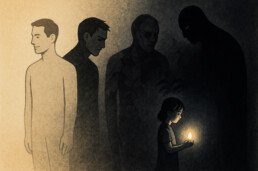
From Dysregulation to Evil: When Fear Becomes Power and Systems Lose Humanity
Understanding How Disconnection Shapes Behaviour, Narcissism, and Harm
When we begin to recognise dysregulation in ourselves, we start to see it everywhere — in others, in relationships, in workplaces, and within the very systems that shape society.
What begins as an individual survival response — a nervous system doing its best to stay safe — can, without awareness, evolve into something far more destructive when fear and disconnection are left unhealed.
This is the pathway from dysregulation to narcissism, and, at its extreme, to evil — the absence of empathy and the enjoyment of another’s suffering.
From Safety to Survival: How Fear Changes Us
In my last blog, Through the Windows of the Nervous System, I explored how our inner state shapes how we see the world:
- Ventral (Harmony) — the state of connection, safety, and compassion.
- Survival (Chaos) — the state of fear, control, and self-protection.
- Dorsal (Collapse) — the state of hopelessness, shutdown, and despair.
Most people move between these states throughout life — dysregulated, yet still capable of care.
But when fear becomes a person’s foundation — when safety is never known — the nervous system hardens. Empathy fades. Control replaces connection. Power becomes protection.
What begins as survival can grow into a need for dominance.
And this is where narcissistic energy begins to form.
The Push-Pull of Narcissistic Supply
Narcissistic dynamics are fuelled by control and dependency — the constant pull for validation and power.
Those trapped in this state feed on emotional energy — positive or negative. Attention equals existence.
When connection is only experienced through control, others are not seen as people, but as suppliers of self-worth.
The push-pull dynamic emerges:
- Idealise → Devalue → Discard → Repeat.
- Love bomb → Withdraw → Manipulate → Punish.
This cycle gives the narcissistic system the illusion of control and superiority. Yet beneath it lies the same truth as any trauma response — a terrified, disconnected self, incapable of true intimacy.
At the extreme end of this spectrum lies sadism — the enjoyment of pain, humiliation, or suffering in others.
This is evil in its purest form: the inversion of empathy.
Where compassion once protected connection, cruelty now protects power.
The Neurobiology of Disconnection
According to Dr Stephen Porges’ Polyvagal Theory, when safety is lost, the body moves from connection (ventral) into defence (sympathetic) or collapse (dorsal).
If this remains unresolved, the nervous system rewires itself for control, not compassion.
Dr Daniel Siegel’s Interpersonal Neurobiology reminds us that healthy human minds integrate empathy, emotion, and reason.
When integration breaks down — whether through trauma, neglect, or abuse — the result is fragmentation.
This fragmentation explains why narcissistic and psychopathic individuals can appear calm and logical while inflicting harm. They are disconnected from their own pain — and therefore disconnected from the pain of others.
Their nervous system no longer signals “this is wrong.”
Their power becomes their regulation.
Control becomes their calm.
When Systems Mirror Trauma
When unhealed individuals build and run systems, the systems themselves become dysregulated.
Fear-based leadership mirrors the fight response — controlling, punishing, dominating.
Collapse-based systems mirror dorsal shutdown — ignoring, neglecting, and abandoning.
And narcissistic systems mirror both — manipulative, image-obsessed, self-serving, and detached from truth.
These systems gaslight, silence, and scapegoat.
They defend reputation, not people.
They reward compliance over conscience.
They are addicted to power — and power, to them, is survival.
This is how institutions — created to protect — end up perpetuating the very trauma they were designed to prevent.
The Descent from Dysregulation to Evil
When fear turns to control, and control to cruelty, humanity is lost.
The descent can be traced as:
- Survival: Fear, scarcity, defensiveness, self-focus.
- Narcissism: Control, manipulation, lack of empathy, self-inflation.
- Psychosis: Detachment from reality, projection, delusion.
- Evil: Conscious or unconscious delight in another’s pain.
Evil is not simply the absence of good — it is the perversion of connection.
It is when pain becomes entertainment.
When lies become strategy.
When suffering becomes acceptable.
And when systems are run by those in these states, the harm spreads — cascading through society, breaking hearts, spirits, and lives.
The Role of Truth and Boundaries
The antidote to evil is not hatred — it’s truth.
Truth anchors us in reality. It ends the gaslight. It exposes manipulation.
Boundaries are how we protect that truth.
They are not punishments — they are protection from further harm.
When we hold boundaries rooted in compassion and clarity, we stop participating in the energy exchange that fuels narcissistic systems.
We stop being supply.
We step out of fear.
We return to truth.
Truth brings light.
Boundaries hold it steady.
A Call to Awareness
We are living through a time where dysregulation has become normalised — in politics, leadership, media, and relationships.
We see fear disguised as power, manipulation masquerading as authority, and cruelty justified as control.
But humanity was never meant to operate in survival mode.
We were built for connection, truth, and love.
Evil only thrives when people stop feeling, stop thinking, and stop questioning.
Healing begins when we dare to see what’s really driving behaviour — fear, pain, and profound disconnection.
The deepest evidence of humanity lost is found in the abuse and exploitation of children. When adults harm or neglect a child — physically, emotionally, or systemically — they have lost touch with their own humanity. It is the ultimate manifestation of evil: the powerful preying on the powerless, feeding off innocence instead of protecting it. This is not strength. It is disconnection so profound that empathy no longer exists. Healing our world begins with protecting our children and confronting the systems and individuals that fail to do so.
When we no longer value life, we lose ourselves. When we stop respecting or upholding the rights and choices of others, the very essence of humanity begins to erode. When the miracle of life is dismissed as a burden, when greed replaces gratitude, and when morality is traded for convenience or power, we step into darkness. When people become collateral damage — replaceable, disposable, dehumanised — it is time for the world to stop and take a long, honest look at itself.
We are here, right now. Living in a moment where our collective nervous system mirrors the chaos and disconnection we see around us. This is our opportunity — perhaps our last — to remember what it means to be human.
The Way Back to Humanity
Every act of truth-telling, every healthy boundary, every moment of co-regulation and compassion — these are how we reclaim humanity.
The world changes when people become conscious of the states they live and lead from.
When they recognise that empathy is not weakness — it’s power.
And that love — not domination — is the highest form of strength.
Because a regulated world will not need to control, destroy, or dehumanise.
It will simply understand.
Humanity heals when we remember that love is not weakness, and truth is not attack. When we meet fear with compassion, and greed with grace, we begin to rise. We do not need to agree to come together — we only need to care. The world changes the moment we choose connection over control, kindness over cruelty, and courage over silence.
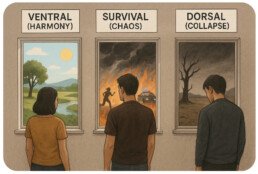
Through the Windows of the Nervous System
How Our Inner State Shapes the Way We See the World
In the same room, three people stand side by side — yet each looks out of a different window.
One sees harmony.
Another sees chaos.
The third sees hell.
These three windows represent how we experience life through our nervous system.
Each window filters the world through the lens of our past experiences — shaping not just what we see, but how we feel and respond to what’s in front of us.
What’s often misunderstood is that it’s almost impossible to truly comprehend the views from the other windows when you’re looking through your own. From the ventral window, it’s difficult to grasp the sheer pain or panic seen through the survival or dorsal lenses. From dorsal, harmony is visible only in others — a distant concept that feels unreachable. You may know joy exists, yet you cannot feel it. When you are disconnected or in despair, hope belongs to someone else’s world, not yours. Each state carries its own reality — and until safety returns, that reality feels absolute.
Window One: Ventral (Harmony)
When our nervous system feels safe, we experience the world through the ventral lens — a state of connection, calm, and presence.
From this window, life feels balanced. We can love, laugh, learn, and grow. We can think clearly and trust others.
Secure attachment, consistent care, belonging, respect, purpose, and emotional safety form the foundation of this view. Our inner sense of safety is mirrored in our outer world. Relationships feel stable. We have space for empathy and curiosity. We can see possibility.
This is where self-worth, compassion, and authentic connection thrive.
Window Two: Survival (Chaos)
When early life or ongoing stressors threaten safety — whether through wilful or unintentional neglect — our nervous system shifts into survival mode.
Parents working long hours, bullying, poverty, frightening experiences, discrimination, war, or abuse — all can disrupt the sense of safety needed for secure attachment. Even well-meaning disconnection leaves a child vulnerable and alone with feelings too big to manage.
Through the survival window, the world looks dangerous and unpredictable.
Our body prepares to fight or flee.
Emotions run high.
We feel anxious, reactive, and on edge.
The body doesn’t trust stillness — it confuses calm with risk.
Survival mode serves a purpose — it’s the body’s way of saying I need to stay alive. But living here long-term exhausts us. We can’t rest, we can’t feel safe, and we can’t connect — because safety feels foreign.
Window Three: Dorsal (Collapse)
When fear, terror, and abandonment become too much to bear, the nervous system shuts down to survive.
This is the dorsal state — a barren, hell-like landscape where life feels empty and hopeless.
It’s a form of self-protection through disconnection.
People here often describe feeling numb, detached, or invisible.
It’s not weakness — it’s the body’s last attempt to save itself.
For some, this shutdown can become so deep that the desire to disappear or thoughts of not wanting to exist emerge. These thoughts often reflect the body’s wish for the pain to stop, not a genuine desire for death. It’s a profound expression of hopelessness — a survival response to unbearable fear, loneliness, or despair.
This is the realm often associated with addiction, depression, self-abandonment, and despair. When life has always been unsafe, the nervous system moves between survival and dorsal — never reaching ventral safety.
It’s crucial that society begins to understand this. Assisted suicide bills should never see the light of day without first acknowledging and understanding the dorsal state. Many people who lose hope are not making a conscious choice to die — they are trapped in a physiological state where life feels impossible.
With safety, compassion, and connection, even those deep in dorsal collapse can recover.
Life can and does improve when the nervous system begins to experience safety again.
The Beliefs That Shape Our Biology
We are not born with limiting beliefs — we learn them.
Our earliest experiences teach us who we are and whether the world is safe.
When a child’s emotional needs go unmet, the brain searches for meaning. To preserve the attachment with a caregiver — even one who causes harm — the child’s developing mind concludes:
“It can’t be them… it must be me.”
And so, deep below conscious awareness, beliefs take root:
I’m not good enough.
I don’t belong.
I’m too much.
I’m unlovable.
It’s my fault.
These beliefs aren’t truths — they are protective adaptations. They form in an attempt to make sense of emotional pain and to stay connected to those we depend on.
But over time, these beliefs shape our neurobiology — influencing how our nervous system responds to the world.
When we believe we are unworthy of love, the body braces for rejection.
When we believe the world is unsafe, the nervous system stays hyper-alert.
When we believe we don’t matter, we unconsciously move toward collapse.
These internalised stories become filters through which we interpret every word, gesture, and silence. They influence our relationships, our choices, and even how we perceive facial expressions and tone of voice.
Generationally, these beliefs — and the survival responses they create — are passed down. A parent who has never known safety cannot easily teach it. A nervous system shaped by fear raises another nervous system shaped by vigilance.
This is how trauma becomes woven through families and societies — not because of weakness, but because of adaptation.
Society, too, carries its own inherited beliefs — passed down through generations as unspoken rules of survival. When people were taught that expressing feelings was a sign of weakness, that message served a purpose once — to help communities stay strong and functional during hard times. The same applies to beliefs like “Don’t expect too much” or “Be grateful for what you’ve got.” During wartime or periods of scarcity, such beliefs offered protection and control in chaos. Yet, when those conditions no longer exist, these old rules continue to shape behaviour — stifling emotional expression, limiting self-worth, and keeping humanity collectively restrained by the echoes of survival.
The pioneering work of Dr. Stephen Porges and his Polyvagal Theory helps us understand how these adaptations live within the nervous system — shaping our perception of safety, danger, and connection. Similarly, Dr. Daniel Siegel’s research in Interpersonal Neurobiology illuminates how our brains and relationships are intertwined; how safety and attuned connection literally rewire the brain. Together, their work shows that healing doesn’t happen in isolation — it happens through safe relationships, connection, and understanding the body’s intelligent design to protect us.
Behaviours Are Expressions of State
Our behaviours are not random. They’re outer expressions of inner experiences.
When we understand nervous system states, we understand people.
To someone anchored in ventral safety, the world feels stable and trustworthy. Boundaries make sense. Reasoning feels natural. But to someone in survival or dorsal, the same restriction can feel like a threat to existence.
For those in survival, restrictions trigger panic — they fight to stay free because safety has always meant control or danger.
For those in dorsal, restrictions confirm hopelessness — they give up, seeing no way out.
This is why the same situation evokes vastly different reactions.
We see through the window we’re standing at.
Understanding the Nervous System is Understanding Humanity
When we meet people through the lens of judgement rather than curiosity, we miss the truth of their pain.
When we impose rather than co-regulate, we deepen the disconnection.
Safety, truth, and compassion are the foundations for healing — not control, fear, or manipulation.
Untruths, gaslighting, and emotional deceit destabilise the nervous system. They unanchor us, creating confusion and mistrust.
We’ve seen this globally — from governments, media, and systems that promised protection yet caused harm. The result? Collective dysregulation. A world in chaos.
Co-Regulation Before Self-Regulation
No one learns self-regulation in isolation.
Co-regulation — being soothed and held in the safety of another’s calm presence — must come first.
Only then can the nervous system internalise what safety feels like and begin to self-regulate.
We need one another. Healing begins in relationship.
The World as a Mirror of Our State
The outer world reflects our collective inner state.
During the pandemic, we saw survival mode on full display — people fighting over supplies, hoarding, taking more than they needed.
It wasn’t just greed. It was fear.
Survival mode is, by definition, selfish — it’s the body’s instinct to save itself.
But survival of the fittest isn’t the same as preservation of humanity.
When we abandon empathy, we abandon ourselves.
If you recognise yourself in the words above, please know this: the state you’re in is not who you are — it’s where your nervous system is. Healing is always possible. Even when it feels hopeless, the body and brain can find their way back to life, connection, and safety.
If you are struggling with thoughts of ending your life or feeling that you can’t go on, please reach out for support. You are not alone. You are not broken. You are a human being doing your best to survive — and there is always a way back to safety.
🌍 Wherever you are, there is help available:
- UK: Call Samaritans at 116 123, or text SHOUT to 85258 for free, confidential help.
- USA: Call or text 988 to reach the Suicide and Crisis Lifeline.
- Canada: Call or text 988 for the Suicide Crisis Helpline.
- Australia: Call Lifeline at 13 11 14 or text 0477 13 11 14.
- If you are outside these regions: Visit findahelpline.com for a global directory of local and international crisis helplines in your country.
The Way Forward
The solution is presence.
Anchoring in truth.
Returning to the body, the breath, the moment.
From here, mind, body, and soul can reconnect.
When we learn to recognise which window we’re looking through — and extend compassion to those looking through another — we begin to heal not only individually, but collectively.
Truth and safety restore trust.
Trust restores connection.
Connection restores humanity.
And that’s where we’ll find our way home — together, through the window of harmony.
May we all learn to see one another through the window of compassion — remembering that every person is viewing life through their own story of survival, strength, and hope. When we return to love, truth, and presence, we return to humanity itself — and from there, healing begins.
Written by
Deborah J Crozier
Person-Centred, Trauma-Informed Practitioner
Chartered Fellow (ACCPH)
Human Observer — Rooted in Love and Truth - Faith in Humanity.
What It Really Means to Be Trauma-Informed and Person-Centred
The terms trauma-informed and person-centred are often used in today’s conversations about wellbeing, education, and social care — but rarely do they capture the depth of what these approaches truly mean.
Being trauma-informed is not about excusing poor behaviour or avoiding accountability.
It’s not about being “soft” or turning everyone into snowflakes.
And being person-centred is not about pleasing everyone or offering endless comfort.
Both are about authentic human connection — meeting people with empathy, fairness, and honesty, while maintaining healthy boundaries and encouraging personal responsibility.
Understanding Without Excusing
A trauma-informed approach recognises that pain often drives behaviour — but that pain never justifies harm.
When someone acts from a place of fear, anger, or control, their nervous system is attempting to protect them. Punishment and humiliation don’t teach regulation — they teach fear.
And fear has never worked as a sustainable motivator for change.
It drives behaviour underground, fuels shame, and causes further dysregulation — in both the person receiving it and the person delivering it.
Healing, accountability, and genuine change come from understanding, not punishment.
What Happens in Survival Mode
When someone is triggered, their body instantly shifts into survival mode.
This is not a conscious choice — it’s an automatic response from the nervous system.
The brain detects threat, whether real or perceived, and the amygdala (the brain’s alarm system) takes over.
At that moment, logic, reasoning, and calm communication become temporarily unavailable because the prefrontal cortex — the part of the brain responsible for rational thought — goes offline.
The nervous system activates one of four main survival responses:
- Fight – becoming defensive, argumentative, angry, or controlling.
- Flight – avoiding, escaping, or withdrawing emotionally or physically.
- Freeze – feeling stuck, numb, or unable to speak or act.
- Fawn – appeasing, people-pleasing, or over-accommodating to stay safe.
Each of these is an intelligent, protective response that once kept the person alive.
But when triggered in everyday life, these reactions can create misunderstanding, conflict, or shame — especially when the person themselves doesn’t realise they’re in survival mode.
When Fear Meets Fear
When someone in survival mode meets another person who is also triggered — whether a parent, teacher, partner, colleague, or professional — fear meets fear.
Both nervous systems signal threat.
Both bodies respond with heightened energy, tension, or defensiveness.
No one feels safe enough to listen or connect.
A raised voice, a sharp look, or a judgmental comment can reinforce the sense of danger — even if the intention was to help.
Fear adds to fear, and both people move further away from understanding.
This is where self-awareness and regulation become essential.
When one person pauses, breathes, and grounds themselves, they send a message of safety to the other nervous system.
That’s co-regulation — the healing power of calm presence.
How the TRUST Framework Interrupts the Cycle
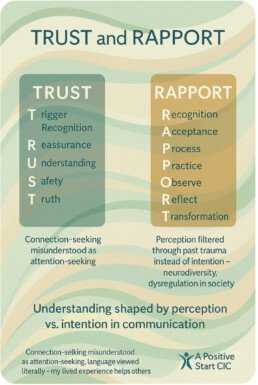
Our TRUST framework was created to help individuals and organisations interrupt the fear cycle and return to safety and connection.
T – Trigger Recognition
By recognising triggers — in ourselves first — we step out of reaction and into awareness. Naming the feeling or sensation immediately begins to lower the threat response.
R – Reassurance
Reassurance communicates safety: through tone, eye contact, or calm energy. It tells the other person’s nervous system, “You are not in danger.”
U – Understanding
Understanding dissolves judgment. It allows curiosity to replace criticism and restores compassion — both toward ourselves and others.
S – Safety
Safety rebuilds trust. Whether through environment, language, or consistency, safety enables people to reflect, learn, and grow.
T – Truth
Truth grounds everything. It’s not about being “nice”; it’s about being real.
Truth holds us accountable, builds integrity, and ultimately forms the foundation of trust.
When we practise TRUST, we respond from awareness, not instinct.
We move from reaction to reflection — from fear to presence.
From Awareness to Action – The RAPPORT Approach
The RAPPORT approach complements TRUST by guiding individuals through the inner journey of self-awareness and growth.
R – Recognition – Notice your internal state with honesty.
A – Acceptance – Allow what is present without denial or shame.
P – Process – Gently work through emotions, sensations, and thoughts.
P – Practice – Apply new skills through repetition and self-kindness.
O – Observe – Cultivate mindful awareness of patterns and triggers.
R – Reflect – Learn from each experience with compassion.
T – Transformation – The natural outcome of consistent awareness and understanding.
Together, TRUST and RAPPORT help us respond consciously, connect deeply, and evolve personally — the heart of trauma-informed, person-centred living.
Living the Core Conditions
Carl Rogers’ core conditions of the person-centred approach — Congruence, Unconditional Positive Regard, and Empathic Understanding — are not just counselling tools; they are principles to live by.
- Congruence invites honesty. It’s the alignment of our inner and outer worlds.
- Unconditional Positive Regard reminds us that worth is never earned; it’s inherent.
- Empathic Understanding allows us to walk beside another person without judgement or agenda.
When we embody these qualities, we nurture connection between mind, body, and soul.
We begin to experience life not from survival, but from presence.
This connection is a deeply spiritual experience — not defined by religion, but by relationship:
our relationship with ourselves, with others, and with something greater than fear.
It’s the quiet knowing that we are safe, seen, and significant — and that others are too.
From Theory to Real Life
The TRUST and RAPPORT approaches were developed through my work with others and through my own lived experience of trauma and healing. I saw — in therapy rooms, classrooms, families, and community settings — that fear-based responses don’t heal pain, they multiply it.
Our approaches were born from the need to bridge understanding between theory and real life. They help people make sense of what’s happening in the moment — inside themselves and in others — and give them a language for what they feel but can’t always explain.
In education, for example, children’s connection-seeking behaviour is too often misunderstood as attention-seeking.
This misunderstanding comes from a lack of awareness of the nervous system.
What looks like defiance or disruption is often a child’s way of saying, “I don’t feel safe.”
When teachers, parents, or carers can recognise this through a trauma-informed lens, everything changes.
Instead of escalating the behaviour, they meet the need.
Instead of punishment, there is connection — and from connection, learning and regulation can begin.
Language plays a crucial role here too. Words carry energy and meaning.
A single phrase, tone, or label can either calm or trigger the nervous system.
With the rise in neurodiversity, it’s even more important that we understand how language is received. Many people process words literally, drawing meaning from the exact phrasing rather than the intention behind it.
This is often the case in those who’ve experienced complex trauma, where perception is filtered through a lens of past pain and threat.
A simple comment meant lightly can feel deeply personal when heard through a traumatised or dysregulated nervous system.
That’s why awareness, empathy, and clarity of language are vital — they prevent misunderstanding and rebuild trust.
Being trauma-informed is not about walking on eggshells.
It’s about communicating with care and consciousness — aware that what we say and how we say it can either reinforce fear or restore safety.
A Culture of Compassion with Boundaries
A truly trauma-informed society is not one without conflict — it’s one where conflict can be navigated safely.
It’s a society that values compassion and accountability, empathy and boundaries, honesty and respect.
When we embody the principles of TRUST and RAPPORT, we create relationships — at home, in schools, workplaces, and communities — where people can be both seen and safe.
Where truth replaces fear.
And where healing becomes possible not through control, but through connection.
Because that’s what it really means to be trauma-informed and person-centred —
honest, compassionate, and grounded in truth.
About the Author
Deborah J Crozier is the Founder of A Positive Start CIC and a Trauma-Informed, Person-Centred Counsellor specialising in trauma, emotional regulation, and recovery. Through her lived experience and professional practice, Deborah leads community and professional programs that restore connection, build resilience, and create trauma-informed systems rooted in compassion, safety, and truth.
📍 A Positive Start CIC
8 Sandbed, Hawick, TD9 0HE
📞 (+44) 01450 367422
📧 info@apositivestart.org.uk
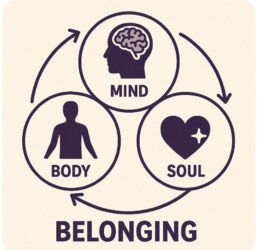
TRUTH: The Anchor for Healing and Mental Wellbeing
At A Positive Start CIC, we speak often about T.R.U.S.T., because without trust, there is no safety — and without safety, healing cannot happen.
Our T.R.U.S.T. framework reminds us that:
✨ T – Trigger recognition
✨ R – Reassurance
✨ U – Understanding
✨ S – Safety
✨ T – Truth
Truth is more than a word.
It’s an anchor — something the body feels when we are connected and safe.
It brings coherence to the mind, steadiness to the body, and peace to the soul.
When truth is missing — through lies, gaslighting, or manipulation — we become unanchored.
The brain searches for meaning, the body searches for safety, and the soul feels lost.
Truth is what allows us to make sense of our world and return to regulation.
The Trinity of Mind, Body & Soul
We are not separate parts — we are one whole being.
Mind – how we think and make meaning
Body – how we sense, feel, and respond
Soul – the essence of who we are, our truth, and our connection to something greater
When mind, body, and soul are in flow, we experience clarity, balance, and peace.
When one part disconnects, the whole system feels it.
Society often separates these — talking about “mental health” as if it exists in isolation, discouraging emotional expression and labelling sensitivity as weakness.
But that’s not true.
Healing comes through integration — when we allow our emotions to be felt, our truth to be spoken, and our body to rest in safety.
Attachment, Connection & Belonging
We are hardwired for connection — not just to people, but to places, moments, and meaning.
From birth, we seek attachment — that deep, instinctive bond that tells us we belong.
We are designed to receive a particular type of care:
💛 Care that says “You matter.”
💛 Presence that says “I see you.”
💛 Consistency that says “You are safe.”
When that care is absent, unpredictable, or conditional, the nervous system struggles to rest.
Without safe attachment, we can become dysregulated — not because we are broken, but because our bodies are still searching for what they were wired to receive.
Belonging is more than being included — it’s feeling safe enough to exist as ourselves.
Truth within connection brings that belonging. It allows the body to exhale and the soul to remember: “I am safe. I belong.”
At A Positive Start CIC, we believe that truth is medicine for the nervous system — it restores safety, strengthens attachment, and allows mind, body, and soul to return to flow.