
The Value of Life in a Culture of Convenience
I shouldn’t have to say this, but I will: this isn’t about looking left or right. Sadly, we’ve become so polarised as a society that not making that clear can create hostility and resentment for simply sharing thoughts and opinions. My intention here is not to argue politics, but to stand back, take a wider view, and ask: what is the true value of life?
From its very beginning in the womb to its final breath, life has always been sacred, precious, and worthy of reverence. Yet, in many ways, our modern culture has drifted from that understanding. We see it in how pregnancy is often spoken of as a burden rather than a gift, and in how we now debate assisted suicide as though life itself can be reduced to a choice of convenience.
Recently, I watched a college campus debate between Charlie Kirk and a young woman on the subject of abortion. The young woman asked:
“Are you suggesting I leave college to take care of a kid if I happened to get pregnant?”
Charlie replied:
“You don’t just ‘happen’ to get pregnant. It’s not like catching the flu or COVID. If you engage in coitus, there is always a chance of pregnancy. That requires responsibility.”
What struck me was how pregnancy was framed—as something casual, almost accidental, something to fear—rather than the creation of a child within her own body.
As a mother, that saddens me. Somewhere along the way, our culture shifted from viewing birth as a miracle to seeing it as a burden.
If we look at the nativity story, the circumstances were far from ideal. Mary’s pregnancy was unplanned in earthly terms and carried very real fears: her safety, her reputation, her future. In fact, it’s worth remembering that as recently as 60 years ago, single mothers in Western societies were often ostracised, shamed, and in many cases institutionalised simply for being pregnant outside of wedlock. No such treatment awaited the absent father. Against that backdrop, Mary’s situation would have been deeply precarious. Yet she gave birth in a stable, with none of the comforts we expect today. Still, the child’s arrival was celebrated—angels rejoiced, shepherds gathered, kings travelled with gifts. Joseph chose to stand by her. Despite hardship, Jesus’ birth was recognised as holy, joyful, and worthy of gratitude.
Now compare that with many modern experiences:
- Pregnancies are often met with stress, anxiety, or even shame.
- Fathers frequently walk away, leaving mothers to carry the weight alone.
- Economic pressures—housing, debt, insecure work—add to the burden.
- The miracle of new life is too often overshadowed by fear or despair.
So what changed?
In Western societies, the journey has been complex:
- Industrialisation & Urbanisation (1800s): Communities shifted from large extended families to more isolated city living, weakening natural support systems.
- The Sexual Revolution (1960s–70s): Freedom expanded, but responsibility was not always emphasised, as contraception and abortion became more available.
- Rising Individualism (late 20th century): Success and personal goals began to outweigh family and community life, with pregnancy seen as an interruption rather than a natural stage of it.
- Economic and Social Pressures (today): The high cost of living, unstable jobs, and reduced social cohesion have made many fear bringing children into the world.
From a faith perspective, children are always a gift and a calling, entrusted to us by God. Life itself is sacred, carrying immeasurable worth, even when circumstances feel overwhelming.
From a secular perspective, the decline of community, the breakdown of family structures, and rising economic insecurity have left many without the practical and emotional support needed to welcome new life with joy.
Alongside this, I cannot help but think about what is happening here in the UK with the assisted suicide bill, which has already reached the House of Lords. It reflects another step in how we as a society are redefining the value of life — this time at its end.
When we no longer celebrate birth as a miracle, and instead often see it as a burden, it’s perhaps no surprise that we also begin to see life’s later years as disposable, as something to end when it feels inconvenient, painful, or costly.
This trend — from how we view pregnancy to how we view old age or illness — reveals a consistent theme: a culture that increasingly measures life by convenience, productivity, and circumstance, rather than its inherent dignity and worth.
Both faith and history remind us that life, from its very beginning to its natural end, is sacred. When we lose sight of that, we risk losing not only reverence for others but also our own humanity.
Both lenses point to the same truth: we need to rebuild how we honour birth and support parents. Every child has the potential to bring light, love, and hope into the world—but only if we as a society choose to see them as a blessing rather than a burden.
I know this in my own life: my children made my life worth living despite hardship and pressures. In the midst of challenges, they gave me joy, purpose, and a reason to keep moving forward. They remain my greatest gifts.
So how do we return to valuing the gift of life? Perhaps it begins with shifting our perspective — from seeing life as something to manage or fear, to recognising it as sacred, even when it comes with hardship. It means supporting mothers and fathers, strengthening families and communities, and choosing compassion over judgment. It means teaching our children that their lives are not measured by convenience or productivity, but by their inherent worth. If we can reclaim reverence for life at its beginning and its end, perhaps we can begin to heal the spaces in between.

When Humanity Loses Its Way
Recently, I witnessed people rejoicing in the death of a young father.
Equally as shocking was that a violent and disturbing video of his murder was shared and reshared online and witnessed by millions — including children.
To me, this notion is abhorrent. I cannot align myself with any ideology that seeks to justify the death of another human being. Whoever it is, whatever the circumstances, celebrating loss of life is wrong. It hurts my soul.
I don’t consider myself right or left. I hold a balanced view. I don’t agree with everything others think or feel, but that has never stopped me from being kind, respectful, or empathic. I know early on whether someone’s views differ from mine, and I don’t feel the need to change them. Our experiences are unique, and they shape our perceptions and beliefs. When I listen, I learn, and I come to understand their perspective. I may not agree with their view but I can respect their right to hold it.
Likewise, others do not have to agree with my views. Everyone is free to step away, and I will respect their right to do so. In the same way, I will exercise my right to speak my truth in a thoughtful manner.
It is also important to say this: not everyone who disagrees with an ideology is “far right” or “far left”.
Politicians and the media often use this label to dismiss those who simply see the world differently. But disagreement itself is not extremism. Many people disagree with each other on countless issues. To reduce every difference to “far right” or “far left” is a distortion that silences voices, shuts down dialogue, and prevents the possibility of repair. We cannot go on like this. It is destructive to humanity.
I have also been shocked by the number of people — and the positions they hold — who think it is acceptable to justify a person’s death. This shows just how desensitised people have become. But desensitisation is a trauma response. If we have any hope of saving ourselves, we need enough people to snap out of that disconnect in order to prevent disaster.
What troubles me most is how disconnection and dissociation have stripped us of empathy. When we cut ourselves off from our own emotions, we lose the capacity to feel for others. We are not meant to live as “heads on sticks” — separate from our bodies. Yet that is how so many exist: in their heads, disconnected, numbed.
Trauma lives in the body. We cannot outthink it. Healing requires bottom-up intervention, but instead people are offered medication that keeps them in a state of suspended animation, not healing, just surviving - or CBT online - that treats thoughts as the root cause but doesn’t address the trauma. Life is not only think > feel > act. It is also - feel > think > feel > act. CBT has its place, but it should not be the only alternative available.
What we are witnessing now is generational complex trauma unfolding in real time. Disconnected people believe that the feelings activated inside of them are caused by something or someone outside of them. Their egos and lack of understanding keeps them from asking: what is my part in this suffering? Why are these feelings here inside me? What are the messages I’m receiving? They react not to the present, but to the past carried within them. Disconnection breeds anger and rage, misalignment of self, and an unwillingness to take responsibility because responsibility is painful.
Instead, blame is projected outward. We see it everywhere — the culture of entitlement, the demand for free services without taking responsibility for self, the instant cancelling rather than rupture and repair, the shameless rejoicing in harm. Neural pathways shaped by trauma make it feel natural, but it is not humane.
Social media, and now AI, mirror and magnify this cycle. Dysregulation spreads through our governments, our services, our communities. It is global.
And yet, there is a solution.
Love, compassion, and empathy can save humanity and it begins with regulation, connection, and self-awareness.
The world — and my shoulders — are big enough to carry a wide range of opinions. But we must draw the line before reaching violence or celebrating murder.
Lord, hear our prayer.
Self-Abandonment, Boundaries, and the Balance of Rights
Self-abandonment often begins quietly. It’s the small moments where we silence our truth to keep the peace, where we say “yes” when every part of us longs to say “no.” It can look like:
- Allowing others to decide for us, even when we feel uneasy.
- Walking away from relationships, not because they’re unsafe, but because we didn’t feel safe enough to speak up.
- Carrying resentment instead of voicing our needs.
At first, these choices may feel protective. But over time, they disconnect us from ourselves. Instead of guarding our wellbeing with clear boundaries, we protect others’ comfort at the expense of our own. This is self-abandonment.
The Cost of Being Out of Alignment
When we abandon ourselves — going against our values, wishes, or choices — we create an internal split. We may tell ourselves we are keeping the peace, but inside, a very different story unfolds.
Self-abandonment breeds dis-ease, resentment, and anger. Our nervous system feels the impact, shifting into dysregulation because we are living out of alignment with who we truly are.
What looks like compliance on the outside is conflict on the inside. And over time, this inner conflict erodes our health, our relationships, and our sense of self.
The Wound of Being Abandoned by Others
Self-abandonment isn’t the only wound we carry. There is also the pain of being abandoned by others — when those who should protect, respect, or stand with us instead turn away.
This can take the form of:
- Injustice, where systems fail to act fairly.
- Betrayal, when people we trust dismiss or minimise our truth.
- Exclusion, when our needs or rights are consistently overlooked.
Abandonment by others strikes deeply at our sense of safety and belonging. It tells our nervous system: you are not safe, you are not seen, you are not supported.
Just like self-abandonment, this can lead to dysregulation — cycles of fear, anger, and despair. Injustice is not just an external issue; it becomes an internal burden, one the body and mind must carry.
The Myth of “Either/Or” Rights
Many people grow up believing that for one person to have their rights, another must lose theirs.
- “If you set a boundary, you’re being controlling.”
- “If you disagree, you’re against me.”
- “If you say no, you’re rejecting me.”
This either/or thinking isn’t truth — it’s fear.
The reality is, rights are not finite. Your right to rest doesn’t erase my right to work. My right to say no doesn’t cancel your right to ask.
Healthy relating begins with recognising that both truths can coexist.
When Choice is Overridden
At the heart of abuse lies one simple dynamic: one person’s choice is overridden by another’s.
- Overriding a no is a violation.
- Demanding surrender for connection creates harm.
- Insisting that one person’s safety or comfort matters more undermines trust at its core.
When we believe our rights automatically outweigh someone else’s, we step into imbalance — and that imbalance corrodes relationship.
When Protection is One-Sided
Sometimes systems, families, or conversations tilt so that one person becomes protected while the other remains exposed.
- The loudest voice sets the tone while others fall silent.
- Organisations prioritise their image instead of those harmed.
- Families tiptoe around one member’s comfort while ignoring the pain of another.
In these moments, the unprotected person learns: your voice, your needs, your safety do not matter. This normalises self-abandonment and fuels cycles of harm.
Making Room Without Surrender
Boundaries are not walls; they are doorways with a lock.
They allow connection and safety. They let us stand in our truth without erasing someone else’s. They remind us that self-respect is not cruelty.
And when others will not — or cannot — respect our boundaries or our rights? We stand firm, with dignity. We remain grounded in our truth, even if it means stepping back.
Saying No is Not Cruelty
Saying no to someone does not make a person unkind or cruel. If someone senses another may be unsafe or harmful in any way, it is their right to put in a boundary and protect themselves.
And in that decision, their opinion matters most.
- Whether the other person believes they are safe does not outweigh someone’s felt sense of safety.
- Other people’s opinions about what they “should” tolerate are irrelevant.
Each of us has the right to decide what is safe for ourselves — because we are the ones who must rely on our own judgement and boundaries to safeguard our wellbeing.
When people lack boundaries themselves, they often struggle to respect the boundaries of others. They may imagine they can demand, harass, or threaten their way past them. But that behaviour is not evidence the boundary was unnecessary — it is proof that the boundary was essential.
Boundaries are not rejection. They are protection — of safety, dignity, and peace.
Protected Characteristics and Boundaries
Sometimes, when we stand our ground or put in a boundary, people may respond by pointing to “protected characteristics.” It can feel like we’re being accused of discrimination simply for saying no or honouring our own needs.
It’s important to understand what this really means.
What Protected Characteristics Are
In UK law (Equality Act 2010), protected characteristics are specific categories — such as age, disability, race, religion, sex, or sexual orientation — where it is unlawful to treat someone unfairly because of who they are. These protections are vital. They exist to ensure dignity, equality, and fairness.
What They Are Not
But having a protected characteristic does not override another person’s rights, boundaries, or choices.
- A boundary is not discrimination.
- Respecting yourself is not unfairness.
- Saying no does not mean denying someone else’s humanity.
Protected characteristics ensure equality — they are not a tool for erasing someone else’s autonomy.
Rights and Balance
My right to hold a boundary can exist alongside your right to dignity.
Your right to fairness does not mean I must abandon myself.
True respect makes room for both.
At its heart, this is about balance: creating a world where all people are protected, but no one is erased. Boundaries and rights are not enemies — they are companions. And the foundation of healthy connection is honouring both.
When Empathy Gets Weaponised
Empathy is a strength, but it can be misused. Too often, we are told that to be “good,” “kind,” or “compassionate,” we must tolerate harm, overlook red flags, or silence our own needs.
In these moments, empathy is weaponised against us. It becomes a tool for manipulation, where our care for others is used to make us abandon ourselves.
But here’s the truth:
- Empathy without boundaries excuses harm.
- Boundaries without empathy create hardness.
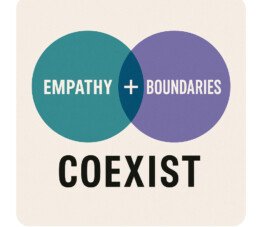
- Together, empathy and boundaries create safety.
When we are accepting of ourselves, when we approve of who we are and what we need, we can stand tall and say no — and mean it. Not with cruelty, but with clarity. Not with fear, but with confidence.
And in that moment, guilt and shame lose their grip.
Empathy + Boundaries Coexist
A common fear is that if we set boundaries — or even choose to exclude someone from our lives — we must harden our hearts and switch off empathy. But that’s not true.
Empathy is our capacity to understand another person’s feelings or situation. Boundaries are how we protect our own. These are not opposites — they can live side by side.
- I can understand why you act the way you do… and still decide your behaviour is not safe for me.
- I can care about your struggle… and still say “no” when your actions hurt me.
- I can wish you well… and still step back if being close means abandoning myself.
Excluding someone from our life doesn’t mean we lose compassion. It means we’ve recognised that connection without safety is too costly.
The shift is this:
- We don’t need to stop feeling.
- We don’t need to abandon our empathy.
- What we do need is to stop abandoning ourselves.
True empathy includes ourselves in the circle of care.
The Invitation
We can make room for others without surrendering ourselves.
We can honour our rights while honouring theirs.
We can stay connected without abandoning our truth.
Because a healthy relationship is never built on erasure or surrender — it’s built on respect, dignity, and the space for both voices to stand.
Compulsion, Relief, and the Possibility of Change
Lately I’ve been reflecting on the nature of compulsion — how the body can drive us toward destructive relief, even when the cost is high.
This post is not written as a statement of fact, nor as a denial of anyone’s lived experience. It is an exploration. I’m asking questions shaped by my own history of trauma and compulsion, and wondering whether neuroplasticity might hold insights that could ease suffering in conditions such as Body Integrity Dysphoria.
I don’t have BID, and I cannot know what it is like to live with it. What I do know is the torment of a compulsion so strong that it once cost me stability, relationships, and safety — until I began to understand what was happening in my nervous system.
This blog is an attempt to reflect, to wonder aloud, and to invite dialogue — perhaps even from neuroscientists, therapists or others who can bring further light to the questions I raise.
“Wild horses couldn’t stop me.”
That’s the only way I can describe the compulsion that once ruled my life. I could not stay where I was. Every cell in my body pulled me towards running, my mind ached with intensity, and the pain of trying to restrain myself became unbearable. Eventually, I always had to go.
It wasn’t adventure or choice. It was torment. I traded stability, relationships, and belonging for the fleeting relief of escape. Over time, this became my pattern: moving house after house, address after address, place to place — over 50 in total. Running felt like the only way to survive.
The Destructive Nature of Compulsion
Watching the BBC documentary Complete Obsession (2000), which looked at Body Integrity Dysphoria (BID), I recognised something hauntingly familiar. People spoke of the unbearable desire to remove a healthy limb — not as preference or fantasy, but as an inescapable compulsion.
I need to be clear here: I don’t have BID, and I don’t know what it means to live with that experience. I’m not claiming my story is the same. What I do know is what it felt like to live with my own destructive compulsion — and in hearing the voices of those in the documentary, I sensed an echo of that torment.
For them, the promise of amputation seemed to offer relief from a lifelong burden. For me, moving again and again offered relief from the rising agony in my nervous system.
In both cases, the pattern appears similar:
- Relief is found through self-destructive means.
- The pain of resisting is worse than the cost of giving in.
- Outsiders struggle to comprehend why someone would do this to themselves.
The question is why.
The Dilemma of Decision-Making Without Lived Experience
One of the things that troubles me most is how decisions are sometimes made about people without truly understanding what it feels like to be them.
- How can someone who has never felt their body drag them relentlessly toward destruction — every cell screaming, every thought consumed — know what it means to live with that kind of compulsion?
- How can anyone confidently label it a “disorder,” or decide that cutting away a healthy limb is the “solution,” without knowing the why behind it?
For me, the “why” was post-traumatic stress. My brain had misinterpreted everyday signals — a frown, a look, a disapproving sigh — as threats to life. That miswiring drove my entire body to run, no matter the cost.
Something has led to these compulsions in people with BID too. Until we understand what and how, we risk rushing to solutions that may quiet the symptom but miss the root.
My Why
For me, the answer was trauma. My nervous system had learned to interpret almost any sign of disapproval as a threat to life.
In those moments, my body reacted as though death was imminent. My heart raced, my muscles surged with energy, and my entire being screamed flee. This wasn’t drama. It was survival, as encoded by a traumatised brain.
Understanding this was key. Once I realised that my compulsion was not madness but a survival reflex, I could begin to work with it. By learning how my body held fear, and finding ways to calm and regulate it, I gradually built new neural connections.
It took time, patience, and repeated safe experience, but eventually the compulsion loosened its grip. I’ve now lived in the same place, in the same relationship for almost 10 years — something I once thought impossible.
The Hypothesis: Can Neuroplasticity Help?
This is where my story touches BID.
- If my brain could rewire its survival circuitry over time…
- Could the same be true for those whose brains misfire around body ownership?
- Could neuroplasticity — the brain’s lifelong ability to change — offer healthier options beyond the drastic relief of self-harm?
I don’t claim to know the answer. I don’t know if my experience is even comparable. What I am doing is asking the question.
Because my experience makes me wonder: if neuroplasticity could help a traumatised brain loosen the chains of compulsion, might it also help a brain that misrepresents its own body?
An Open Question
I ask this not to minimise or convert, but to explore. What’s happening in the minds, brains, and bodies of people with BID? Could understanding neuroplasticity one day open safer, more compassionate ways of easing their suffering?
For me, compulsion nearly destroyed my life. Learning about my nervous system gave me another option. Perhaps — just perhaps — the same principle could offer hope in places where relief currently comes only at great cost.
Reference: Horizon: Complete Obsession (BBC, 2000).
Body Integrity Dysphoria – Wikipedia overview
Watch the video here 👇
http://ok.ru/video/281953962725
If Not for Everyone, Then for Whom?
Therapeutic Principles as a Way of Being
“We do not owe everyone we encounter therapeutic principles.”
That was a comment left on one of my blog posts by an accredited therapist and supervisor. It was even endorsed by others.
I’ve been reflecting on what this means — not only for us as therapists, but for the clients and communities we serve. Because for me, therapeutic principles are not tools I switch on for work and off when I go home. They are not reserved for paying clients. They are values I live by.
Coming Home to Carl Rogers
When I first discovered Carl Rogers’ On Becoming a Person, I felt excited — and relieved. Excited, because I had finally found words for something I had always known. Relieved, because I realised I had been “person-centred” long before I had any training.
Rogers taught that the six core conditions for therapeutic change were not techniques, but qualities of presence:
- Congruence – being real, genuine, and whole.
- Unconditional positive regard – valuing people without condition.
- Empathic understanding – truly sensing the other’s world as if it were your own.
- Along with psychological contact, presence, and the client’s perception.
These aren’t simply things we do as therapists; they are ways of being.
You Can’t Be Two People
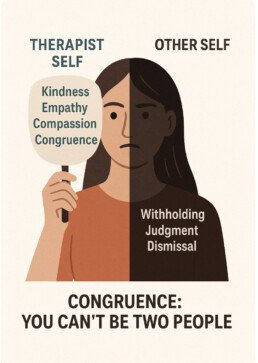
And that’s why the comment troubled me. We cannot authentically be two people: the “therapist self” who shows compassion in session, and the “other self” who withholds it from those we disagree with. That is incongruence — and people sense it instantly.
We don’t give everyone therapy — of course not. But we do owe people empathy, compassion, and understanding. Not because it’s our job, but because it’s our humanity.
And it matters most with those we disagree with. It’s easy to offer empathy when we’re aligned. It is harder, but infinitely more important, when we’re not.
Safety Without Judgement
Another response suggested that sometimes we need judgement to assess safety. But here’s the distinction:
- Physical safety may require firm boundaries and decisive assessment.
- Emotional safety comes from compassion, empathy, and reassurance — never from judgement.
Assessment is not the same as judgement. We can meet people exactly where they are, without withdrawing unconditional positive regard.
Empathy Without Self-Abandonment
But what about when someone has harmed us? How do we remain empathic without harming ourselves or becoming incongruent?
This is where boundaries and truth-telling matter. Empathy doesn’t mean excusing harm or staying silent. It means understanding the humanity of the other, while still honouring our own.
A real-life example:
Imagine someone you trusted betrayed your confidence.
- Without boundaries: you say nothing, try to “be empathic,” but inside you feel resentful and unsafe. That’s incongruence and self-betrayal.
- With judgement: you attack them — “You’re untrustworthy, you’ve ruined everything.” That may protect in the moment, but it destroys dialogue.
- With empathy + boundaries:
“When you shared what I told you, I felt hurt and unsafe. I need confidentiality in my relationships, so I’m going to take a step back for now. I can also imagine you may have felt under pressure in that moment. I don’t excuse it, but I want to be clear about its impact.”
This way you:
- Stay congruent by speaking your truth,
- Protect yourself with boundaries,
- And still offer empathy for the other’s possible experience.
That is empathy without self-betrayal.
Motivation and Intention
For me, it always comes back to awareness: what’s my motivation, what’s my intention? Am I activated and coming from a survival response, perhaps reacting to a past hurt, or am I being congruent and responding in the present?
I’ve reflected on why I felt moved to respond to that comment with a blog post. Part of it is that I felt minimised and misquoted. And part of it is because I genuinely believe it is the wrong message to be teaching therapists — that we do not “owe” people therapeutic principles. If we start from there, we risk undermining the very foundation of our work.
Why It Matters
If therapists believe compassion and empathy are optional — owed only to some — then no wonder so many people feel unseen and unsafe. We risk replicating the very exclusion our clients come to us to heal from.
Carl Rogers called person-centred practice a way of being. That’s exactly how I see it too. These principles don’t end when the therapy session ends. They extend into how we treat shop staff, strangers on the bus, colleagues online, and those whose views we oppose.
Listening to understand — not simply to defend — is where connection begins.
Congruence: You can’t be two people.

Working Man – A Song That Holds Our Story
The first time I heard Working Man by Celtic Thunder, originally written by Rita MacNeil, I felt as though someone had captured the echoes of my childhood and poured them into song. The words carried me back to the mining village where I grew up, to the men who worked underground and the families who carried that weight above it.
This post is also written for a dear friend. They reminded me of this song only this morning, sharing how deeply personal it is for them during an incredibly difficult time. It struck me that music often does that—it surfaces memories, it connects us across experiences, and it gives us words when our own are hard to find. So, while this reflection comes from my childhood, it is shared in honour of them too.
The Harsh Reality Beneath the Lyrics
The line “It’s a working man I am, and I’ve been down underground” is more than a lyric—it’s the reality I witnessed in my community. Boys barely out of school put on helmets and boots at sixteen, and before long the coal dust etched itself into their lungs and faces. Life aged people quickly, but it also built a fierce camaraderie. The village beat to the rhythm of the pit whistle, the shifts, and the unspoken knowledge that danger was always present.
When the song speaks of the elder who, at sixty-four, greets you at the door and tells of hardships, I see the faces of men who survived, carrying stories of both pride and pain. Many others never reached that age.
The Miners’ Strike – My Memory at Fifteen
When the miners’ strike came, I was fifteen years old. Too young to understand the politics, but old enough to feel the atmosphere shift. The village that once echoed with laughter and solidarity grew tense. Fear and determination lived side by side.
Families lined up at food banks, mothers stretched every penny, and men stood shoulder-to-shoulder on picket lines, not knowing if their sacrifice would be honoured or forgotten. I remember the silences at the dinner table, the weight in the air, the whispered worries about what the future would hold. It was harsh, divisive, and for many, it marked the beginning of the end—not just of jobs, but of a way of life.
The strike wasn’t only about pay or conditions; it was about dignity, community, and survival. And when it ended, villages like mine were left scarred. Some never recovered. The pits closed, and with them, the identity of whole communities was dismantled.
I will never forget the day I marched with the miners as they walked back to work, defeated - alongside the colliery band, that had been a huge part of my life as a young person. They played as we returned in solemn procession. The music that had once carried pride now carried grief, and in that moment, I felt the full weight of a community broken.
I also remember how the whole village marched together that day, walking with the miners back to the pit. On the way, we stopped at the local bakery to applaud Mr Hardy, a man who had almost bankrupted himself feeding families throughout the strike. It was a moment of deep respect and gratitude—a recognition that his sacrifice had carried the community when times were at their hardest. That gesture has stayed with me all my life: the strength of a village standing together, even in defeat.
Community Lost, Memory Kept
Listening to Working Man now, I don’t just hear a song—I hear the echo of footsteps on the dark streets, the heavy silence after the strike, and the resilience of families who endured the unendurable. I hear the voices of those who never saw the sun again, and the quiet strength of those who carried their memory forward.
The song gives words to what many of us grew up living: the pride and cost of being from a mining village, the grief of community loss, and the enduring love for those who gave their lives to the work.
Why It Still Matters
Songs like Working Man keep our stories alive. They remind us that behind every headline, every strike, every pit closure, were human beings—fathers, mothers, children—who bore the weight of decisions made far away from the coalface.
For me, this song is more than music; it’s remembrance. It’s a way to honour where I came from, to acknowledge the sacrifices, and to carry the light of those communities forward, even when the pits themselves are long gone.
And perhaps it’s no coincidence that years later, I went on to create a Community Interest Company—albeit in a new community I now call home. Because community still matters to me. Looking after each other in times of hardship, loss, and uncertainty matters. People matter—even when the world doesn’t always appear to reflect it.
People may call this emotional. But emotions don’t make us weak—they make us human.
👉 Listen to Working Man here and let it remind you of the resilience, pain, and pride of working-class lives that built our communities, and the cost when those communities were broken apart.
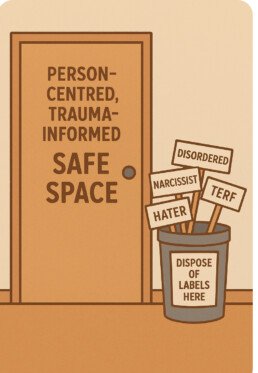
Beyond Labels: Why Name-Calling Harms More Than It Helps
In the run-up to public demonstrations or moments of collective expression, it’s common to see leaders, politicians, and media rushing to apply labels. Before a single banner is raised, the story is already framed: one side dismissed as extremist, the other portrayed as the sole voice of reason.
But labels aren’t neutral descriptions. They are frames — ways of telling the public how to see someone before they’ve even spoken.
The Harm of Political Labels
When figures are branded as far right or far left, it rarely reflects the whole picture. These labels don’t invite conversation; they shut it down. They strip away nuance, dismiss complexity, and encourage the public to view people through the narrowest possible lens.
From a trauma-informed perspective, this is deeply harmful. Every human being has a past — and most of us, if judged only on our younger, more naïve selves, would look very different to who we are today. Growth is part of the human journey. Yet in political discourse, past affiliations or mistakes are often pinned to people forever, as though change were impossible.
What’s striking is the double standard: governments call for trauma-informed rehabilitation for prisoners — recognising the possibility of growth and second chances — while simultaneously denying that same grace to those in public life. We cannot have it both ways. Either we believe people can change, or we don’t.
Too often, people don’t look beyond the label. They parrot what they’ve read in headlines or heard repeated by authority figures, rarely stopping to ask whether it’s fair or accurate. This isn’t because people are thoughtless — it’s because belonging feels safe. It can feel easier to echo the loudest voice than to question it. But if we want real change, we need to be willing to look beyond the ready-made story. We need to ask, what’s underneath the label? What’s the full human story? Only then do we create the possibility of genuine understanding and transformation.
Pathologising Language in Everyday Life
This habit of labelling extends far beyond politics. In everyday conversations, especially around mental health, we often hear pathologising words thrown out casually: narcissist, psychopath, slut. These are not neutral descriptors; they are weapons, used to silence or condemn.
Such words often come from pain, betrayal, or fear. Instead of saying, “I was hurt,” it can feel easier to declare, “They’re a narcissist.” Instead of sitting with discomfort, we reach for a label that ends the conversation.
But these terms serve another purpose too: they divide. They separate us from them. They let us dismiss whole people instead of listening to the point they are trying to make.
The Unequal Weight of Words
What troubles me most is how society treats some labels as unacceptable while others are tolerated. Rightly, many discriminatory slurs are challenged. Yet when people in positions of power fling words like narcissist or extremist, it’s often excused.
Why is one form of dehumanisation condemned while another is normalised? Why do we allow leaders, politicians, and media to use labels as weapons, when in any other context we would call it bullying?
Shouldn’t those with the greatest influence be held to the highest standard of compassion and fairness, not the lowest?
Another subtle harm in labelling is the way it gets reported. We often hear phrases like “self-professed” this or that — as though the person has chosen the label for themselves. In reality, many people have simply been given that label by others. What often happens is reframing: “If this label means I stand for honesty, or fairness, or protecting children, then I’ll wear it.” But that is not the same as self-identification. It is resistance to an imposed name, not genuine ownership of it. Pretending otherwise distorts the truth and keeps the cycle of name-calling alive.
Rupture and Repair vs. Division and Dismissal
In trauma-informed practice, we talk about rupture and repair. Disagreements happen. Misattunements happen. But healing comes in the repair — in the return to empathy, in the willingness to listen, in the rebuilding of trust.
Contrast this with public discourse. Instead of repair, we see rupture upon rupture. Leaders slur those they disagree with. Media caricature complex movements or individuals. Opposing perspectives are written off before they’ve been heard.
This isn’t leadership. It’s childishness dressed up as authority.
Too often in public debate, we don’t really listen. We pause only long enough to prepare our counter-argument, waiting for our turn to speak. That isn’t listening — it’s a form of self-defence. It’s a knee-jerk reaction, rooted in survival mode, where the nervous system prioritises winning or protecting rather than understanding. When we listen only to reply, not to understand, we remain stuck in conflict. Real dialogue begins when we listen with the intent to hear, not the intent to fight back.
Towards Rational Debate and Empathic Understanding
Every perspective — whether we agree with it or not — comes from somewhere. People gather in public because they care, because they want to be heard. They come from different backgrounds, colours, and experiences, often standing together around a shared value. To dismiss all of that with a single political label is misleading at best, and divisive at worst.
A trauma-informed society would do better. It would hold space for rational debate, recognising that disagreement doesn’t have to mean disrespect. It would place empathy at the heart of dialogue, especially towards those we oppose. Because compassion isn’t just for the people we like — it is tested most in how we treat those we don’t.
A Call for Something Higher
We are all more than the worst label ever applied to us. To pin people forever to their pasts, or to weaponise diagnoses and slurs as insults, is both unfair and deeply damaging.
If we want a society that heals, we need leaders, media, and communities willing to rise above name-calling. We need dialogue that is rational, not reactionary. We need empathy that stretches beyond our own tribe.
Because the true measure of compassion is not how we treat those who agree with us — it’s how we treat those who don’t.
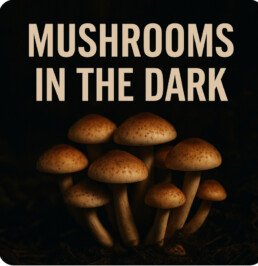
Mushrooms in the Dark
There’s an old saying: “Treat people like mushrooms – feed them BS and keep them in the dark.”
Never has that felt more relevant than today.
Normally, I try not to get into politics. It’s not my world, and I prefer to focus on healing, growth, and the human spirit. But right now, it’s hard not to—because the choices being made ripple into every part of our lives. No one is untouched.
It doesn’t just feel chaotic here in the UK. It seems crazy all over the world. And the systems that were once set up to protect us, to make sure what’s happening now could never happen, are failing. The truth is, they’ve always failed to protect some groups of people. Victims have often been the ones blamed—subjected to rough justice, scapegoated, silenced. It’s not the people governed by these systems who are broken. It’s the systems themselves. And they have been, for as long as I’ve lived.
All around us, decisions are being made that directly affect our lives. Yet instead of honesty and transparency, we’re served fear-mongering, gaslighting, and secrecy. The message from the top seems to be: people are too stupid to handle the truth.
Like narcissists, those in power appear to imagine themselves superior—more capable, more entitled to knowledge—while the rest of us are expected to obey and endure.
We see it in the way plans are quietly published online but never properly explained. Communities are left to stew in worry and speculation instead of being trusted with open dialogue. We see it in how Keir Starmer carries himself as Prime Minister: playing politics like a courtroom battle he intends to win, keeping his cards close, calculating each move, and treating the public as an opponent rather than those he serves.
From plans for “mass fatalities” to schools training for lockdown, to the silencing of voices through arrests, the pattern is clear: sow distress, provoke outrage, and then step in as if to “restore order.” It feels less like governance and more like design.
As someone who studies trauma, I know how repetition shapes the brain. Repetition is the driver of neuroplasticity—the way our nervous systems adapt and rewire. Keep people in survival mode, and you keep them predictable. Threat after threat, division after division—rights removed from some, given to others—like an abusive parent pitting siblings against each other. It ensures our focus remains exactly where those in power want it: on fear, scarcity, and conflict.
This is where the damage goes deeper and division sets in. People getting angry at others for receiving food or heating support while they themselves are struggling to survive. But anger at another person being fed isn’t the way forward. Everyone deserves food, warmth, and dignity. What we should be upset about is the injustice and inequality of the systems—not each other.
But here’s the truth they don’t want you to see:
What we focus on every day becomes the reality we live.
If we continue to feed on the fear, we will live in fear. If we choose instead to focus on the lives we want to experience—connection, safety, dignity, freedom—we begin to carve those into existence.
And the tools we need to rebuild aren’t secrecy, manipulation, or control. They are empathy, kindness, and compassion. These are what heal broken souls and, by extension, broken systems. Yet those qualities are hardest to access when we’re all pushed into survival mode. When people are fighting to survive, their capacity to extend compassion narrows. And that, perhaps, is the most dangerous design of all.
Circumnavigating absurdities may be the sanest act of resistance right now. Turning our attention toward what heals, what builds, and what uplifts may be the most radical form of freedom we have.
Because mushrooms grow in the dark. But people? People thrive in the light.
This is my perspective, given the life I’ve lived.
The Mirror of Projection: Why We See Narcissists Everywhere but Ourselves
The word narcissist has become one of the most overused labels of our time. Scroll through social media or listen to conversations and it doesn’t take long before someone is accused of being one. It’s a word often thrown like a dart—sharp, loaded, and designed to stick.
But what happens when the very behaviours we condemn in others are the same ones we practise ourselves?
What Projection Really Means
Projection is the psychological process of disowning uncomfortable feelings or traits within ourselves and attributing them to someone else. It’s a very human defence mechanism—we all do it. But when projection becomes a habit, it blinds us to the role we play in our relationships and keeps us stuck in cycles of blame.
Consider the behaviours often attributed to so-called “narcissists”:
- Being rude, passive-aggressive, or dismissive.
- Minimising the feelings of others.
- Expecting constant understanding and forgiveness.
- Making demands and becoming angry when needs aren’t met.
- Overriding boundaries or personal choices.
- Judging, criticising, or using sarcasm as armour.
- Asking for advice while secretly believing we know best.
Uncomfortable as it is to admit, most of us have displayed these behaviours at some point. The problem isn’t that we sometimes slip into them—the problem is when we refuse to take accountability, pointing the finger outwards instead: “They’re the narcissist, not me.”
And so the cycle repeats. When someone suggests we might be projecting, the response is often defensiveness—self-pity, guilt-tripping, or manipulation—anything but reflection.
Unseen Currents: Behaviour Beneath the Surface
Why do we find it so hard to see our own patterns?
Because much of our behaviour is shaped outside of conscious awareness. Trauma expert Bessel van der Kolk describes how people become “expert at ignoring their gut feelings and numbing awareness of what is played out inside.” In neuroscience, studies suggest that up to 95% of our brain’s activity is unconscious—meaning most of our thoughts, impulses, and reactions happen beneath the surface.
We may feel the anger, rage, or hurt inside us—but the way it leaks out through our tone, words, or behaviour often sits in a blind spot. These blind spots make projection almost inevitable, because it feels easier to see the problem in someone else than to look within.
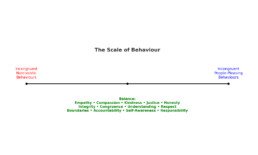
The Swinging Scale of Behaviour
In truth, we are all on a scale, swinging between different forms of incongruence. Sometimes we tip towards narcissistic-style behaviours—self-protective, critical, or dismissive. Other times we swing the other way, towards people-pleasing—over-accommodating, self-erasing, or overly compliant.
Neither extreme brings balance. Both are protective strategies, often rooted in early survival responses.
The real work is to notice the swing within ourselves. To pause before accusing someone else of being “the problem” and ask:
- Am I showing any of these behaviours myself right now?
- What feelings am I struggling to face that I’d rather project outward?
- What might accountability look like in this moment?
The Inversion: When Projection Turns Inward
Projection doesn’t always look like blaming others. Sometimes it flips inward. Instead of calling everyone else the problem, people make themselves the problem — but not in a way that brings growth.
You’ve probably seen it: someone insists everything is their fault, openly declaring their own brokenness or worthlessness. On the surface, it looks like accountability. But often, it’s something different. It’s a way of staying stuck — of drowning in self-hatred, guilt, or shame without ever moving towards change.
This inversion is another form of avoidance. By making it all about “I’m just a terrible person” or “It’s all my fault,” the real work of self-examination gets bypassed. Nothing shifts, because self-blame is being used as another protective shield — a way to gain sympathy, silence criticism, or avoid the discomfort of honest reflection and responsibility.
True accountability isn’t about hating ourselves. It’s about recognising where our behaviours hurt others, and then doing something different.
Finding the Centre
At the centre of this scale sits balance—the place where empathy, compassion, kindness, justice, honesty, and understanding live.
It’s not about perfection. It’s about awareness. It’s about recognising that while projection is human, accountability is healing. When we stop throwing labels and start owning our shadows, we create space for real connection—with ourselves and with others.
Because the truth is, calling someone a narcissist doesn’t make us less so. But choosing empathy, compassion, and self-reflection—that is what breaks the cycle.
Why Self-Compassion Comes First
And this is why we always begin with self-compassion and awareness. Without compassion, self-reflection can easily spiral into self-hatred. But with compassion, we create the safety to look at ourselves honestly.
If even the suggestion of checking ourselves causes deep pain, fear, panic, anxiety, anger, or denial—if our instinct is to avoid, shut down, defend, or deflect—that in itself is worth noticing. Those are signs that something inside us has been activated.
It’s important to remember: triggers live inside us, not in the other person. While someone may spark them, the intensity of the reaction belongs to our own nervous system, our own history.
The invitation, then, is not to judge ourselves but to get curious. To ask:
- What am I feeling right now?
- Why is this so uncomfortable?
- What does this reaction reveal about my own wounds or needs?
Because understanding the what and why of those feelings is the path towards healing. Awareness, paired with compassion, is how we stop projecting outward or collapsing inward—and instead, find the steady ground of balance.
When we start from compassion, awareness becomes liberating instead of crushing. We can admit our flaws without being defined by them. We can see our protective patterns without shame. And most importantly, we can move towards balance — where empathy, kindness, honesty, and justice sit at the centre.
Because the goal is never to be flawless or perfect. The goal is to be human with awareness. And self-compassion is what makes that possible.
In Closing:
Projection can feel like a mirror we want to smash, but if we dare to look into it with honesty, we may just see the path back to balance staring right back at us.
The Girl in the Dirty Dress
The Girl in the Dirty Dress: Shame, Survival, and the Power of Co-Regulation
When our nervous system is overwhelmed, our rational, intelligent thinking brain goes offline. In those moments, the body does what it must to survive. We freeze. We go silent. We disconnect. Years later, many of us look back on those frozen moments with shame, asking ourselves: “Why didn’t I scream? Why didn’t I run? Why didn’t I fight back?”
But these aren’t failures. They are survival responses. And when those responses happen in childhood, they can leave behind powerful images and beliefs that shape the way we see ourselves for years to come.
The Image That Stayed With Me
When I was seven years old, new in a foreign country, a teacher dragged me to the front of the classroom. She pointed to the food stains on my dress and encouraged the other children to laugh at me.
She never asked why my dress was dirty. She didn’t know that the airplane carrying everything we owned had crashed, killing the entire crew. She didn’t know that I had only the clothes I’d arrived in, or that my mother was distraught and bedridden with grief.
So I stood there, cheeks burning, motionless, voiceless, ashamed. And while the teacher shaped how the other children saw me that day, what mattered even more was how I came to see myself.
I was the girl in the dirty dress. Those urghhs and pointed fingers weren’t just playground taunts — they became evidence of my failure. Proof that I didn’t belong. Proof that I would never be good enough or fit in. Even when I could understand the circumstances later on, those truths faded into insignificance. The image of that seven-year-old became a barrier in my mind that I couldn’t move beyond — like the ant trapped inside a circle drawn in chalk, unable to see that the boundary was never really there.
How It Shaped My Adult Life
That moment didn’t stay in the classroom. It followed me into adulthood. I found myself unable to face or speak in front of a crowd. The same burning cheeks, frozen body, and silent voice that had trapped me at seven returned whenever I stood before others.
What I didn’t realise then was that my avoidance of public speaking wasn’t about ability — it was about survival. My nervous system remembered the humiliation, the laughter, the shame. It protected me the only way it knew how: by keeping me away from the threat of being seen.
Recognising the link between that childhood incident and my adult patterns of avoidance was life-changing. It helped me see that the “hand-drawn circle” keeping me trapped was not real. With compassion and co-regulation, I began to step beyond it — one small step at a time.
Trauma and the Dorsal Vagal State
This is what happens to victims. They develop what is often called a victim mentality — not because they are weak, but because they are victims. Their nervous systems have been plunged into the abyss by horrors they could not escape.
Polyvagal Theory, developed by Stephen Porges, explains this with the dorsal vagal state. When fight or flight are not possible — especially when a child faces an adult — the body shuts down. It collapses. It disappears inward. This is not a choice. It is biology.
The problem is that the image of those moments — the freeze, the shame, the silence — becomes etched into memory. Over time, the inner critic uses them as evidence: “See? You’re not enough. You failed. You’ll never belong.” The survival response becomes welded to core beliefs of unworthiness.
The Only Way Back: Co-Regulation
For those who have experienced complex trauma, thinking their way out of dorsal is impossible. The prefrontal cortex — the thinking brain — is offline. The survival brain is in charge.
The only way back from dorsal is through co-regulation.
That means being with someone who is safe, compassionate, non-judgmental, and empathetic — someone who can hold space without shaming, fixing, or minimising.
Carl Rogers called these the core conditions of the person-centred approach:
- Congruence (genuineness),
- Unconditional Positive Regard,
- Empathic Understanding.
Whether offered by a therapist, a loved one, or a trusted friend, these qualities create a safe relational field. Safety allows the nervous system to come back online. It allows connection to replace collapse. It allows healing to begin.
In Conclusion
That seven-year-old girl in the dirty dress stayed with me for many years, shaping how I saw myself and what I believed I deserved. She kept me silent in classrooms, boardrooms, and auditoriums long after the incident was over. But today I know this: she wasn’t a failure. She was surviving the only way her body knew how.
If you carry shame from moments where you froze, went silent, or disappeared — please know this: your nervous system was protecting you. Freezing is not weakness. It is survival.
And survival is something to honour, not condemn.
Be kind to yourself. Self-compassion doesn’t erase the past, but it does release us from the prison of shame. And when we allow ourselves to co-regulate with safe, compassionate others, we find our way back to connection, to healing, and to freedom.
Reflection Prompt
Can you recall a moment when you judged yourself for freezing, going silent, or shutting down?
What might shift if you saw that moment not as failure — but as your body’s wisdom keeping you safe?